
NEWS & EVENTS

- Home
- News
- ESG Weekly News
- ESG International Weekly News 8/10-8/16
ESG International Weekly News 8/10-8/16
August 18,2026
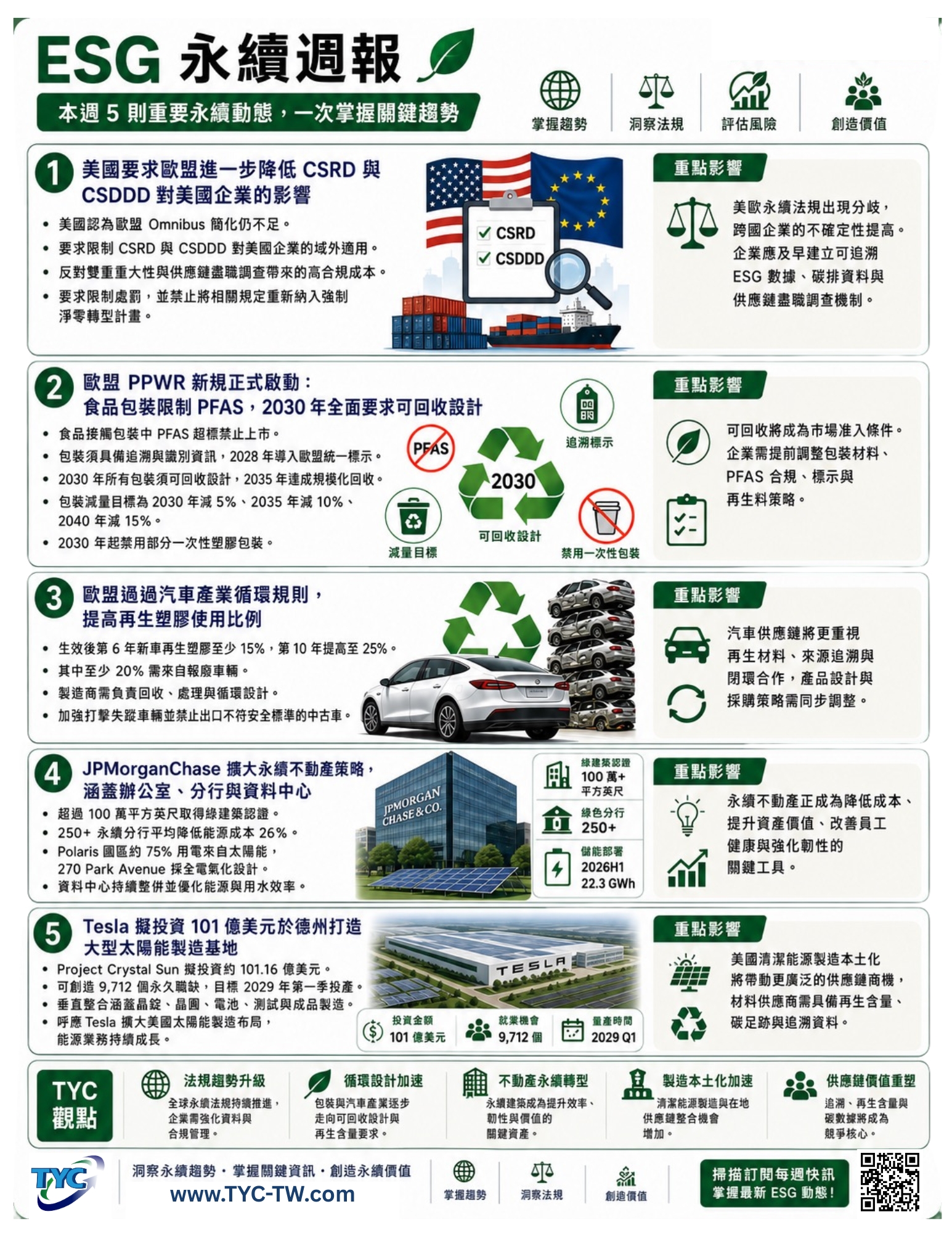
Global Sustainability Rules Are Reshaping Supply Chains: From CSRD and PPWR to Recycled Materials and U.S. Clean-Energy Manufacturing
Global sustainability policy is moving beyond corporate disclosure and increasingly influencing product design, material selection, supply-chain management, and manufacturing strategy.
This week’s five major developments span U.S.–EU regulatory tensions, new EU packaging and automotive circularity requirements, and major corporate investments in sustainable real estate and domestic clean-energy manufacturing.
For manufacturers and material suppliers, future competitiveness will depend not only on price and product quality, but increasingly on traceability, recycled content, carbon data, and the ability to respond to evolving international requirements.
1. U.S. Presses EU to Further Reduce CSRD and CSDDD Burdens on American Companies
The U.S. Government has urged the European Union to further limit the impact of the Corporate Sustainability Reporting Directive (CSRD) and Corporate Sustainability Due Diligence Directive (CSDDD) on American companies.
Although the EU’s Omnibus simplification initiative has already significantly reduced the scope and compliance requirements of both regulations, the U.S. argues that concerns remain regarding extraterritorial application and costly supply-chain due diligence obligations.
Washington has also raised concerns about the EU’s double materiality framework and has requested further limits on enforcement and penalties involving U.S. companies.
The development highlights an ongoing divergence between the U.S. and EU approaches to corporate sustainability responsibility and supply-chain governance.
Even if regulatory requirements are further simplified, multinational customers may continue requesting carbon, traceability, and due diligence information from their suppliers.
2. EU PPWR Begins: PFAS Restrictions and Recyclable Packaging Requirements
The first requirements under the EU’s revised Packaging and Packaging Waste Regulation (PPWR) have begun to apply.
Initial measures include restrictions on PFAS in food-contact packaging, along with new identification and traceability requirements for manufacturers and importers placing packaging on the EU market.
Key future milestones include:
-
Harmonized EU packaging labels beginning in 2028
-
Packaging designed for material recycling by 2030
-
Packaging capable of being collected, sorted, and recycled at scale by 2035
-
Packaging waste reduction targets of 5% by 2030, 10% by 2035, and 15% by 2040
-
Restrictions on certain single-use plastic packaging beginning in 2030
The regulation demonstrates how recyclability is shifting from a voluntary sustainability claim toward a product design and market-access requirement.
3. EU Automotive Circularity Rules Raise Recycled Plastic Requirements
New EU automotive circularity rules bring recycled materials directly into vehicle design requirements.
Under the regulation:
-
At least 15% of plastic used in new vehicles must come from recycled sources six years after entry into force
-
The minimum rises to 25% within ten years
-
At least 20% of the recycled plastic used must come from end-of-life vehicles
The regulation also strengthens extended producer responsibility, covering vehicle take-back, authorised treatment, dismantling, recycling, and circular design.
Future recycled-content targets may also be considered for steel, aluminium, magnesium, and critical raw materials.
For automotive suppliers, material origin, consistency, technical performance, and traceability will become increasingly important.
4. JPMorganChase Expands Sustainable Real Estate Across Offices, Branches, and Data Centers
JPMorganChase is integrating sustainability more deeply into its global real estate portfolio.
In 2024, more than 1 million square feet of its real estate achieved green building certifications. More than 250 Chase branches are now classified as sustainable, with the portfolio reporting approximately 26% lower energy costs since opening.
At the Polaris campus in Ohio, solar installations provide approximately 75% of the building’s electricity needs.
The company’s new global headquarters at 270 Park Avenue in New York is designed as an all-electric tower incorporating advanced ventilation, smart temperature controls, and optimized lighting.
JPMorganChase is also consolidating and upgrading data centers to improve energy and water efficiency.
The strategy illustrates how sustainable buildings are increasingly being treated as tools for reducing operating costs, improving employee well-being, and strengthening long-term asset value.
5. Tesla Proposes $10.1 Billion Texas Solar Manufacturing Campus
Tesla has proposed Project Crystal Sun, a large-scale solar manufacturing campus in Fort Bend County, Texas, with an estimated investment of approximately $10.1 billion.
According to current filings, the project could:
-
Cover approximately 3,050 acres
-
Create around 9,712 permanent jobs
-
Begin commercial production as early as Q1 2029
-
Include vertically integrated production covering ingots, wafers, cell processing, metallization, printing, testing, and finished solar products
The project remains in the proposal stage, and Tesla is also evaluating other potential U.S. locations.
If developed as proposed, Project Crystal Sun could become a major example of domestic clean-energy manufacturing and create broader demand across materials, equipment, construction, logistics, and circular supply chains.
TYC Perspective
This week’s developments point to one consistent direction: sustainability is moving from corporate reporting into products, materials, and supply chains.
First, although sustainability regulations are being simplified and politically challenged in some markets, customer demand for supply-chain information is unlikely to disappear. Carbon data, material traceability, and due diligence documentation may remain important requirements in multinational procurement.
Second, the EU’s PPWR and automotive circularity rules show that recycled materials are increasingly moving from voluntary commitments toward formal product requirements. Suppliers will need to demonstrate not only recycled content, but also traceability, consistent quality, recyclability, and technical performance.
Third, the JPMorganChase and Tesla examples show how sustainability is influencing physical assets and manufacturing investment. From green buildings and data centers to solar manufacturing, the range of potential applications for lower-carbon and recycled materials continues to expand.
At TYC, we continue to monitor global regulatory and industry developments while supporting customers through recycled materials, product carbon footprint data, traceability, and circular applications.
Building more resilient supply chains starts with better material choices.