
NEWS & EVENTS

- Home
- News
- ESG Weekly News
- ESG International News 6/22-6/28
ESG International News 6/22-6/28
June 30,2026
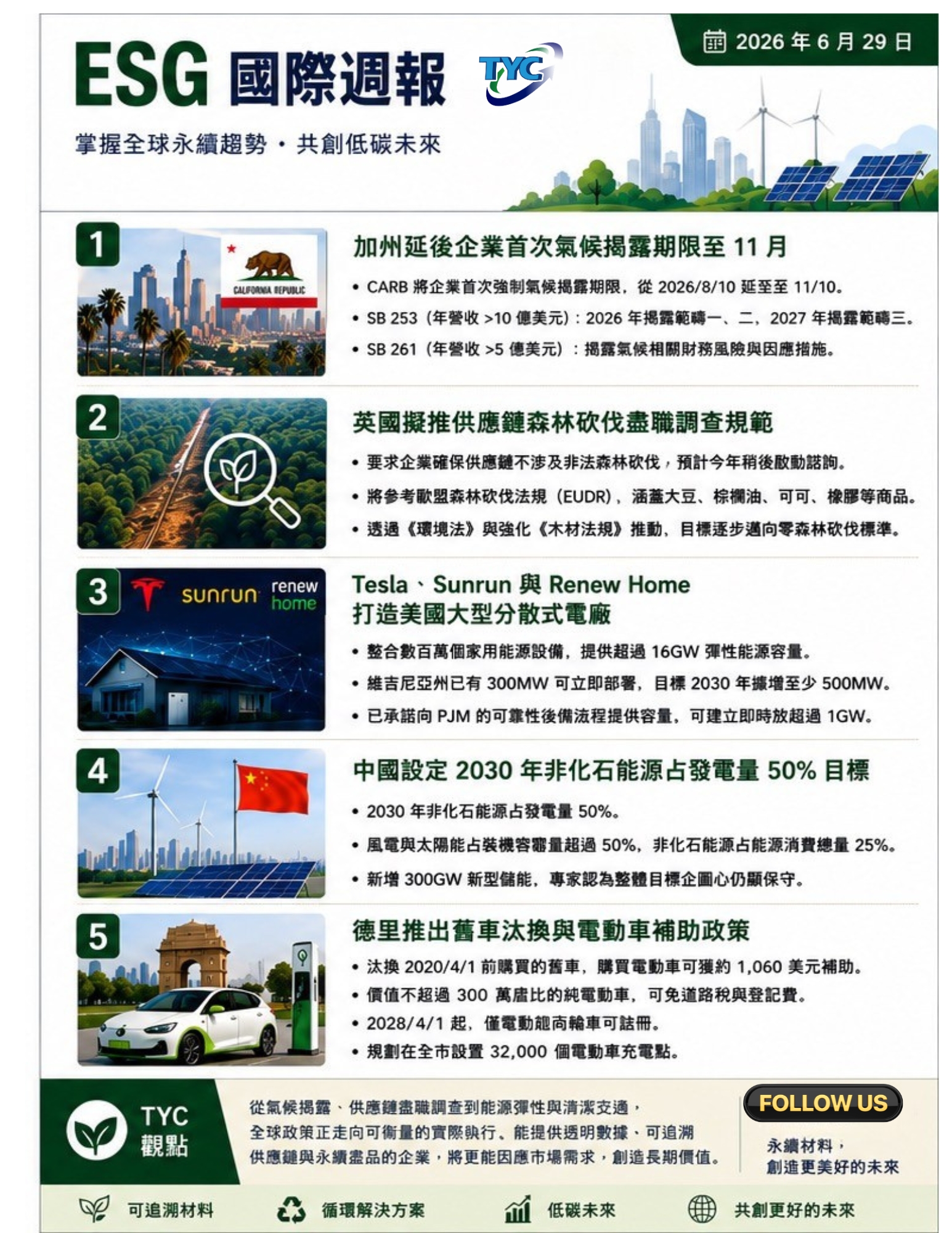
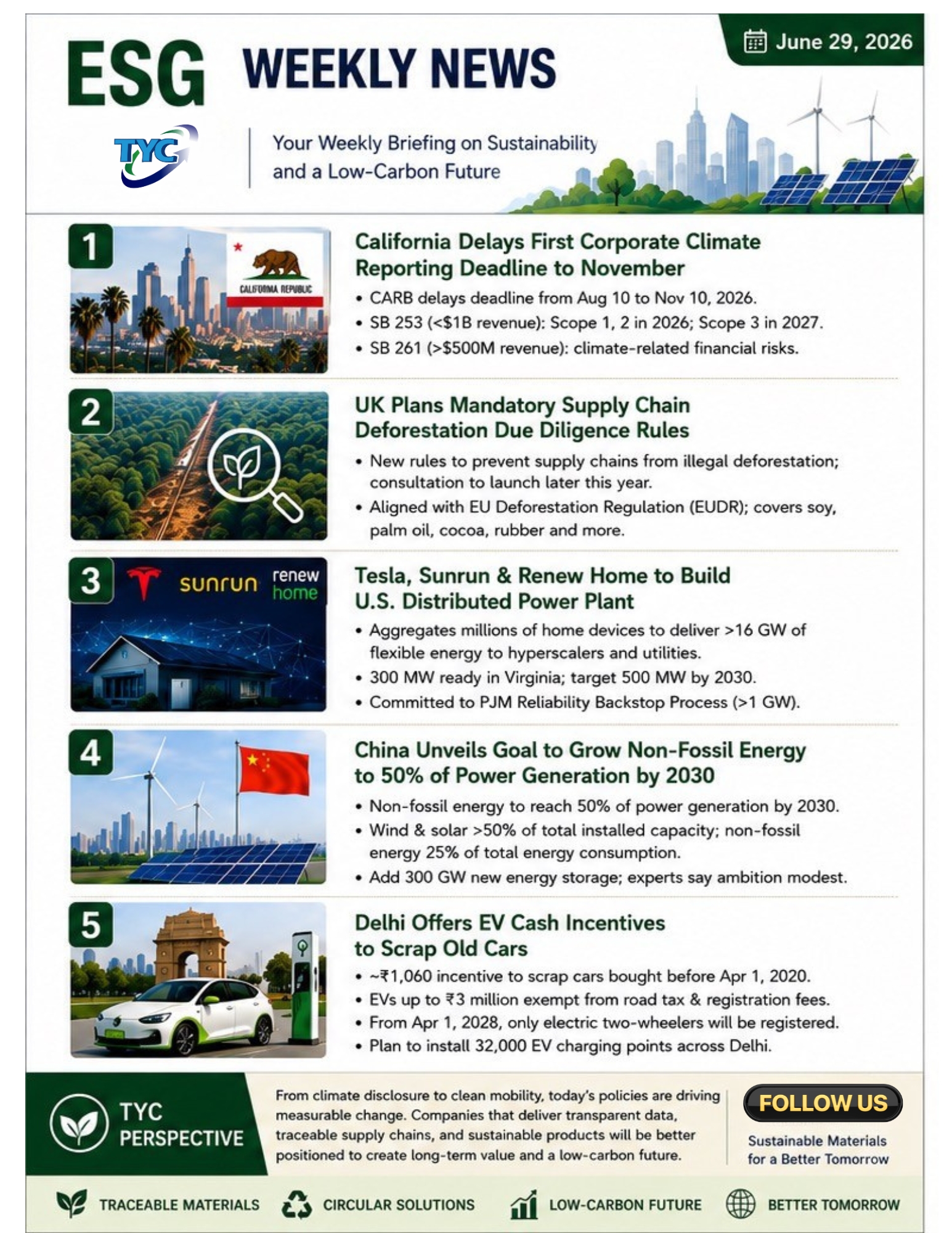
ESG Weekly News|Global Climate Disclosure, Energy Transition & Clean Mobility Updates
This week’s ESG developments highlight how governments, companies, and cities are accelerating climate-related regulation, energy transition, and clean infrastructure planning. From California’s corporate climate reporting timeline to new supply chain due diligence rules in the UK, the global direction remains clear: companies will need stronger data, more transparent supply chains, and practical decarbonization strategies.
1. California Delays First Corporate Climate Reporting Deadline to November
The California Air Resources Board (CARB) plans to delay the first mandatory corporate greenhouse gas emissions reporting deadline from August 10, 2026 to November 10, 2026. The delay is intended to give companies more time as CARB prepares limited changes to the final climate disclosure regulation.
California’s climate reporting laws, SB 253 and SB 261, will introduce major climate disclosure requirements for large companies doing business in the state. SB 253 applies to companies with annual revenues above US$1 billion, requiring disclosure of Scope 1, Scope 2, and eventually Scope 3 emissions. In the first year, reporting will focus on Scope 1 and Scope 2 emissions, while Scope 3 reporting is expected to begin in 2027.
SB 261 applies to U.S. companies doing business in California with annual revenues above US$500 million, requiring disclosure of climate-related financial risks and actions taken to reduce or adapt to those risks. CARB has identified more than 4,000 companies that may fall under the new rules.
2. UK Plans Mandatory Supply Chain Deforestation Due Diligence Rules
The UK Government announced plans to introduce new regulations requiring businesses to ensure their supply chains are not linked to illegal deforestation. A public consultation is expected to be launched later this year.
The proposed rules are expected to align with the EU Deforestation Regulation (EUDR), covering similar core commodities and information requirements. This approach is intended to reduce administrative duplication and support consistent data and traceability standards for companies operating across markets.
The UK Government noted that UK consumption of goods linked to internationally traded commodities is associated with around 29,000 hectares of global deforestation each year and approximately 9.4 million tonnes of related carbon emissions. Commodities likely to be covered include soy, palm oil, cocoa, and rubber.
The proposed framework may be introduced through the UK Environment Act and strengthened UK Timber Regulation. The UK’s long-term ambition is to move toward a broader deforestation-free standard for relevant products.
3. Tesla, Sunrun and Renew Home to Build U.S. Distributed Power Plant
Tesla, Sunrun, and Google-backed Renew Home announced a partnership to aggregate millions of residential energy devices into what they describe as the largest distributed power plant in the U.S. The platform is expected to provide more than 16 GW of flexible energy capacity to hyperscalers and utilities.
The initiative will combine hundreds of thousands of home battery systems operated by Tesla and Sunrun with more than 8 million smart thermostats and connected devices managed by Renew Home. These devices can help shift residential energy demand during peak hours and provide stored solar power back to the grid.
The companies said the solution can be deployed within months without additional hardware, software, interconnection, water, or land use. More than 300 MW of capacity is currently available for immediate deployment in Virginia, with a target of at least 500 MW by 2030. The companies have also committed capacity to PJM’s proposed Reliability Backstop Process, which could unlock more than 1 GW of capacity.
4. China Sets 2030 Goal for Non-Fossil Energy to Reach 50% of Power Generation
China’s National Development and Reform Commission and National Energy Administration announced new energy system goals under a five-year plan. The plan targets non-fossil energy becoming China’s largest electricity source by 2030, accounting for 50% of total power generation.
Other 2030 goals include increasing non-fossil energy to 25% of total energy consumption, having wind and solar account for more than 50% of total installed power generation capacity, and adding 300 GW of new energy storage.
However, some energy transition experts criticized the plan as lacking ambition. Non-fossil energy already accounted for 42.3% of China’s power generation in 2025, raising concerns that fossil-based power generation could still increase if overall electricity demand continues to grow.
China remains the world’s largest greenhouse gas emitter, with coal still representing more than half of its total energy consumption. As a result, the pace of China’s power sector transition remains highly significant for global climate goals.
5. Delhi Offers EV Incentives to Scrap Old Cars
Delhi has finalized a new electric vehicle policy aimed at reducing vehicle pollution and accelerating electric mobility. The policy includes a four-year budget of 150 billion rupees, approximately US$1.59 billion, to support EV adoption and charging infrastructure.
Car owners who scrap vehicles purchased before April 1, 2020 and switch to electric vehicles can receive around US$1,060 in incentives. Battery electric vehicles priced up to 3 million rupees will also be exempt from road tax and registration fees.
The policy includes subsidies for electric scooters and motorcycles, starting at 30,000 rupees in the first year and decreasing over time. From April 1, 2028, Delhi will only register electric two-wheelers, creating a strong regulatory signal for the market.
Delhi also plans to support the installation of 32,000 EV charging points across the city, making charging infrastructure a central part of the policy’s success.
TYC Perspective
This week’s developments show that ESG regulation is moving from broad commitments toward measurable implementation. Climate reporting, supply chain due diligence, energy flexibility, renewable power, and clean mobility all depend on credible data and traceable systems.
For manufacturers and material suppliers, this means customers will increasingly request verified product information, including carbon footprint data, recycled content, sourcing records, and compliance documentation. Companies that can provide transparent, evidence-based environmental information will be better positioned to support global customers facing new climate, supply chain, and infrastructure requirements.
TYC continues to focus on material traceability, recycled material applications, product carbon footprint data, and practical circular economy solutions that help customers respond to changing ESG expectations across international markets.