
NEWS & EVENTS

August 25,2026
TYC ESG International Weekly: CBAM Verification, ISSB, Carbon-Intensity Trading and Circular-Materials Markets
August 17–24, 2026
This week’s sustainability developments highlight the growing importance of emissions verification, globally aligned disclosure standards, lifecycle carbon accounting and the infrastructure needed to support circular-material markets.
From limited CBAM verification capacity and the ISSB’s long-term operating plan to legal uncertainty surrounding California’s packaging EPR program, companies face more than new regulatory requirements. Data quality, third-party assurance, product traceability and practical recycling systems are becoming equally important.
Here are five consequential developments from the week.
1. CBAM Verification Capacity Remains Limited
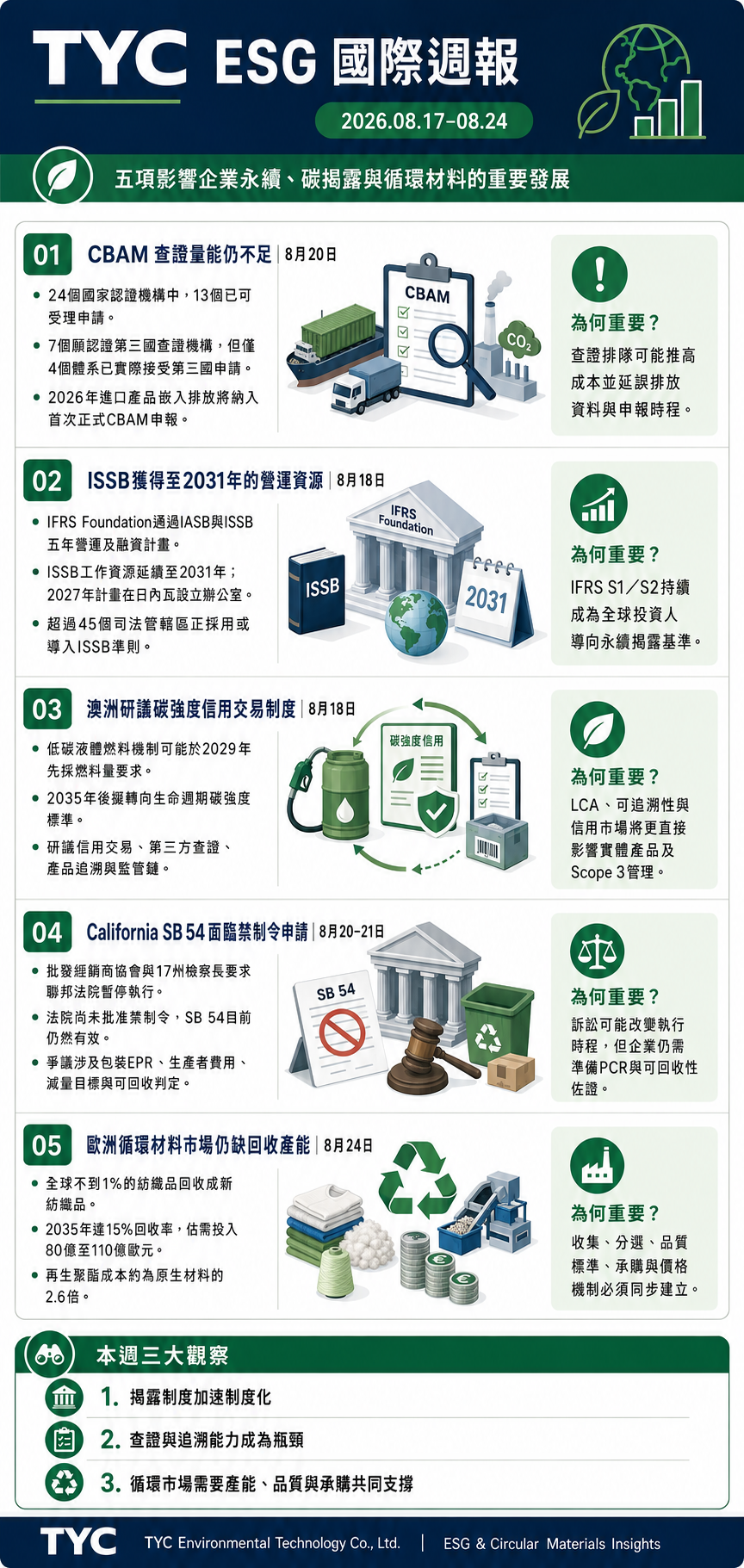
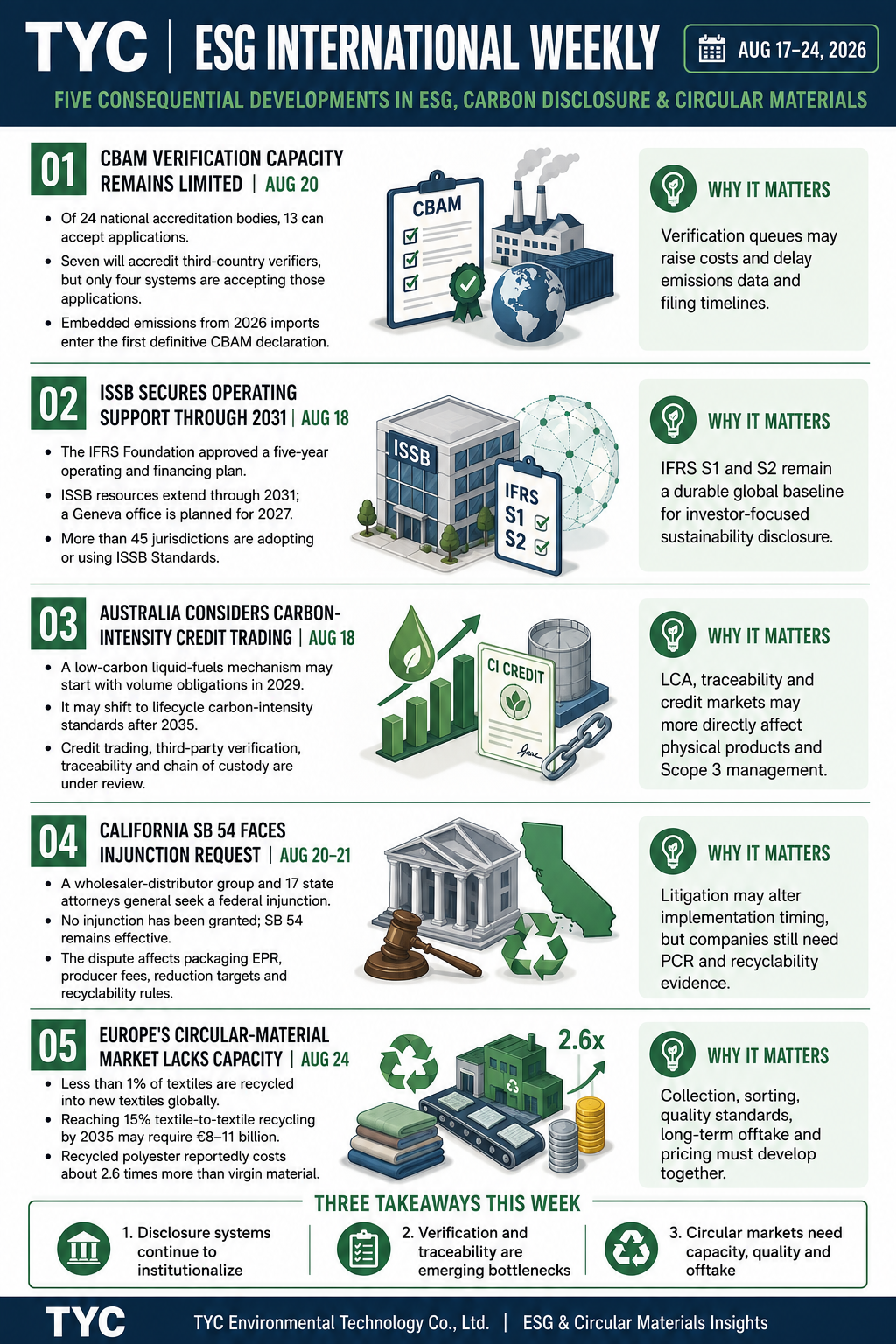
The European Union’s latest update shows that 13 of 24 national accreditation bodies are currently able to accept accreditation applications from CBAM verification organizations.
Seven bodies have indicated that they are willing to accredit verifiers located in third countries, but only four accreditation systems are already accepting third-country applications.
The definitive phase of CBAM is now underway. Embedded emissions associated with goods imported during 2026 will be included in the first definitive CBAM declaration, requiring importers to obtain emissions data and complete the applicable verification process.
Why it matters
A shortage of accredited verification capacity could create longer queues, higher service costs and delays in obtaining verified emissions data. Importers and overseas suppliers may therefore need to confirm calculation boundaries, methodologies and verification readiness earlier in the reporting cycle.
Source: European Commission—CBAM Accreditation Status
2. ISSB Secures Operating Support Through 2031
The IFRS Foundation has approved a five-year operating and financing plan supporting the priorities of both the IASB and ISSB through 2031.
The Foundation also plans to establish an office in Geneva in 2027, strengthening the ISSB’s international coordination and engagement.
More than 45 jurisdictions are currently adopting, using or considering the ISSB Standards. IFRS S1 addresses general sustainability-related financial disclosures, while IFRS S2 focuses specifically on climate-related risks and opportunities.
Why it matters
The ISSB Standards are becoming a durable global baseline for investor-focused sustainability reporting. Even where the standards are not yet mandatory, financial institutions, international customers and supply-chain partners may increasingly request information on climate risks, greenhouse-gas emissions, transition plans and related financial effects.
Source: IFRS Foundation—Five-Year Strategic and Financial Plan
3. Australia Considers Carbon-Intensity Credit Trading
The Australian Government has proposed a policy framework for supporting low-carbon liquid fuels. The mechanism could begin with volumetric fuel obligations in 2029 before transitioning to lifecycle carbon-intensity standards after 2035.
The consultation also considers credit trading, third-party verification, product traceability and chain-of-custody controls. This approach could account for emissions from raw-material sourcing, production, processing and transportation—not only emissions generated when the fuel is used.
Why it matters
Carbon policy is expanding beyond organization-level inventories toward the lifecycle carbon intensity and traceability of individual products.
When comparing the carbon performance of different products, companies will need to clearly disclose raw-material, manufacturing, transportation and lifecycle boundaries. Comparisons based on different system boundaries may otherwise create misleading conclusions.
Source: Australian Government Consultation
4. California SB 54 Faces an Injunction Request
The National Association of Wholesaler-Distributors and attorneys general from 17 states have requested a federal injunction against California’s SB 54 packaging extended-producer-responsibility program.
SB 54 establishes requirements covering packaging and single-use plastic products, including producer responsibility, source reduction, producer fees and recyclability. No injunction has been granted, and the law therefore remains in effect.
Why it matters
The litigation may create uncertainty around California’s implementation timeline, but it does not eliminate the need for companies to prepare.
Documentation supporting recycled-material sources, post-consumer recycled content, product design and real-world recycling conditions remains important. A plastic resin identification code alone is generally insufficient to demonstrate that a product can be practically recycled within existing systems.
Source: CalRecycle—SB 54 Plastic Pollution Prevention and Packaging Producer Responsibility Act
5. Europe’s Circular-Materials Market Still Lacks Recycling Capacity and Offtake
A recent assessment of Europe’s circular-textiles market reports that less than 1% of textiles worldwide are currently recycled into new textile products.
Reaching a 15% textile-to-textile recycling rate by 2035 could require approximately €8 billion to €11 billion in capital investment. Recycled polyester reportedly costs about 2.6 times more than virgin material, reflecting constraints involving collection, sorting, production scale, quality consistency and price competitiveness.
Why it matters
Mandatory recycling or recycled-content targets do not automatically create a functioning circular market.
Collection and sorting infrastructure, material-quality standards, long-term purchasing commitments and viable pricing mechanisms must develop together to support recycling capacity and stable end markets.
Source: Reuters—Europe’s Circular-Textiles Market
TYC Perspective
This week’s developments reveal three connected trends: sustainability disclosure is becoming increasingly institutionalized; verification and traceability are emerging as market bottlenecks; and circular-economy policy is moving beyond recycled-content targets toward practical recycling capacity and long-term offtake.
For the recycled-plastics and circular building-materials industries, PCR content represents only one part of credible circular-material management. Companies also need to understand material origins, product-carbon-footprint boundaries, quality consistency, actual recycling conditions and viable remanufacturing pathways.
Carbon-reduction and recyclability claims should be proportional to their scope and supported by defined methodologies, testing and verifiable evidence.
TYC will continue monitoring developments in sustainability disclosure, product carbon management and circular-material policies to help industry stakeholders understand changing regulatory and market expectations.