
NEWS & EVENTS

- Home
- News
- ESG Weekly News
- ESG International Weekly News 6/8-6/14
ESG International Weekly News 6/8-6/14
June 16,2026
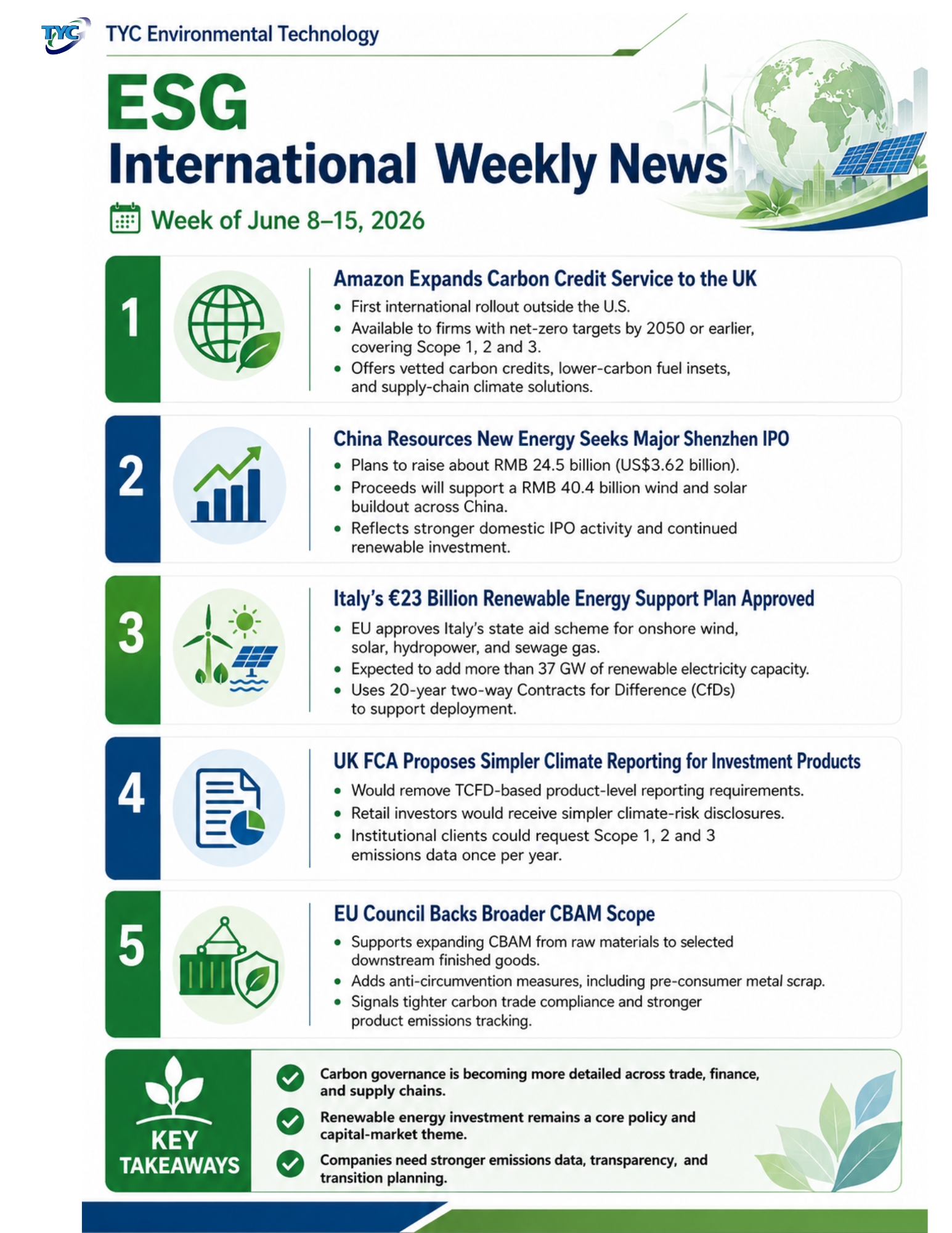
ESG International Weekly News|June 8–15, 2026
This week’s ESG and climate policy developments highlight a clear direction: carbon governance is becoming more detailed, more data-driven, and more closely linked to trade, finance, and supply-chain decisions.
1. Amazon Expands Carbon Credit Service to the UK
Amazon has expanded its carbon credit service to the UK, marking its first international rollout outside the United States. The service is available to companies with net-zero targets by 2050 or earlier, covering Scope 1, 2, and 3 emissions.
Through Amazon’s Sustainability Exchange, eligible companies can access vetted carbon credits, lower-carbon fuel insets, and supply-chain climate solutions. The move reflects growing demand for higher-quality carbon credits, stronger verification, and more transparent climate claims.
2. China Resources New Energy Seeks Major Shenzhen IPO
China Resources New Energy is seeking to raise approximately RMB 24.5 billion, or US$3.62 billion, through a Shenzhen IPO. The proceeds will support a broader RMB 40.4 billion investment plan in wind and solar projects across China.
The listing reflects the continued role of capital markets in supporting renewable energy expansion. It also shows that renewable infrastructure remains a key investment theme, even as project returns face pressure from weather conditions, grid constraints, and subsidy changes.
3. Italy’s €23 Billion Renewable Energy Support Plan Approved by EU
The European Commission has approved Italy’s €23 billion state aid program to support renewable electricity generation. The plan will support onshore wind, solar, hydropower, and sewage gas projects, adding more than 37 GW of renewable electricity capacity.
The program will use 20-year two-way Contracts for Difference, helping reduce market uncertainty and accelerate renewable energy deployment. It also supports Italy’s 2030 renewable energy targets and the EU’s broader Clean Industrial Deal.
4. UK FCA Proposes Simpler Climate Reporting for Investment Products
The UK Financial Conduct Authority proposed removing TCFD-based product-level climate reporting requirements for investment products. The proposal would replace detailed product reports with simpler climate-risk disclosures for retail investors and on-demand emissions data for institutional clients.
The FCA said the change would reduce complexity while keeping climate information useful and relevant. For institutional investors, firms would still need to provide Scope 1, 2, and 3 emissions data upon request.
5. EU Council Backs Broader CBAM Scope
The Council of the European Union has agreed on its position to strengthen the Carbon Border Adjustment Mechanism. The proposal would expand CBAM from raw materials to selected downstream finished goods that use carbon-intensive inputs such as steel and aluminium.
The Council also supports stronger anti-circumvention rules, including bringing pre-consumer metal scrap into scope. This signals that product-level emissions data, supplier traceability, and customs-related carbon documentation are becoming increasingly important for companies trading with the EU.
For plastics and recycled materials, this update is not a direct regulatory change yet. Current CBAM rules mainly focus on sectors such as iron and steel, cement, fertilisers, aluminium, electricity, and hydrogen. However, the broader trend is highly relevant to plastic materials, recycled polymers, and low-carbon building materials. As the EU strengthens embedded-carbon requirements across trade and industrial supply chains, companies may face growing expectations to provide verified carbon footprint data, recycled content documentation, and transparent material traceability.
For recycled plastic solutions, this creates both a compliance signal and a market opportunity. Materials with lower carbon footprints, clear recycled-content certification, and reliable product-level carbon data will be better positioned as global buyers respond to stricter carbon governance.
Key Takeaways
Carbon governance is becoming more detailed across trade, finance, and supply chains.
Renewable energy investment remains a core policy and capital-market theme.
Companies need stronger emissions data, transparency, and credible transition planning.
For low-carbon and recycled materials, the direction is clear: carbon data is becoming part of product competitiveness.