
NEWS & EVENTS

- Home
- News
- ESG Weekly News
- ESG International Weekly News 6/1-6/7
ESG International Weekly News 6/1-6/7
June 09,2026
ESG Weekly News|From Climate Targets to Green Finance: Global ESG Moves Toward Systems, Data and Supply Chain Accountability
This week’s global ESG developments highlight climate policy, renewable energy disputes, green finance growth, anti-greenwashing enforcement, and China’s long-term industrial strategy. From the UK’s proposed 2040 emissions reduction target to the EU’s anti-greenwashing rules and China’s growing green bond market, global sustainability is moving into a new phase defined by regulation, verification and supply chain responsibility.
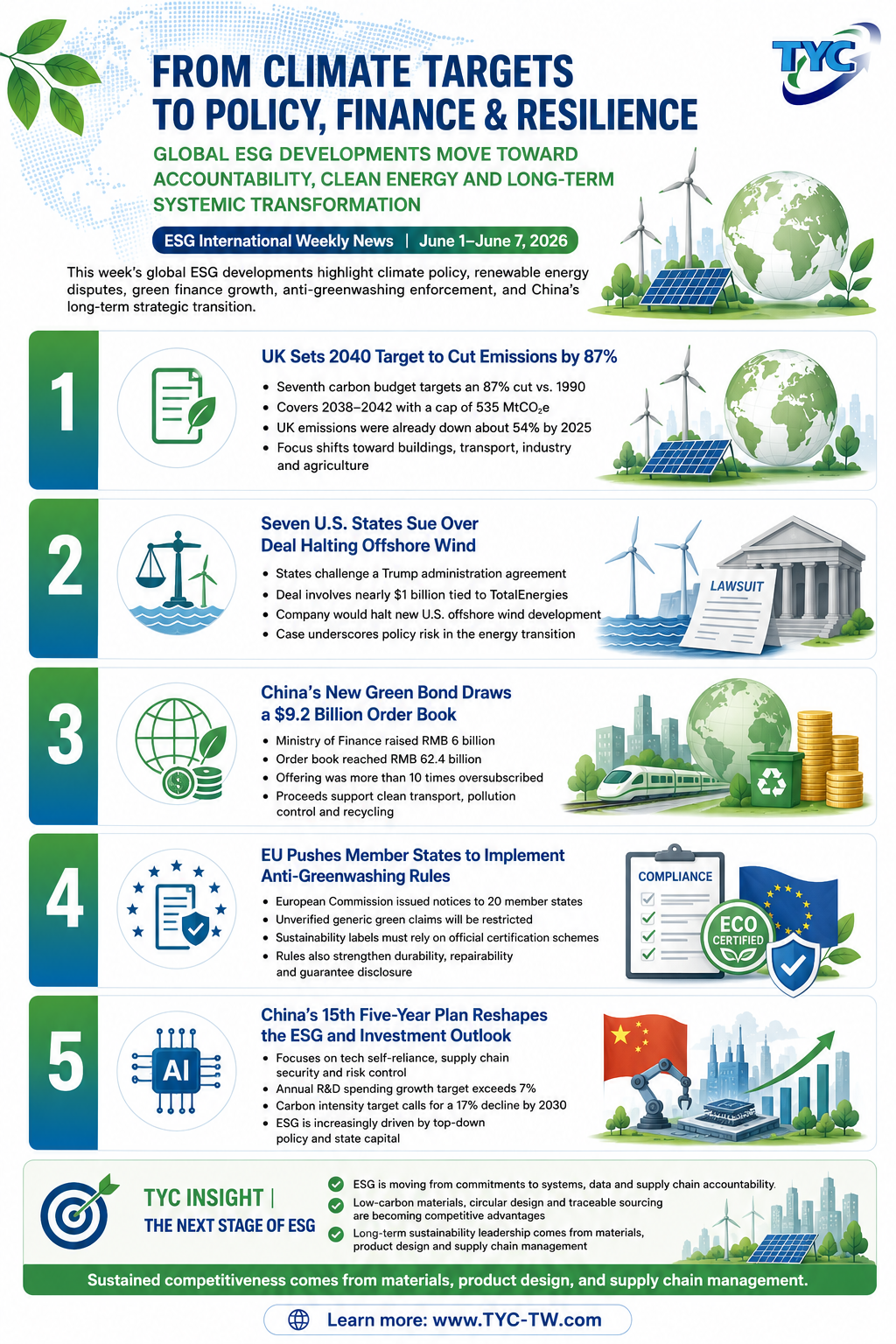
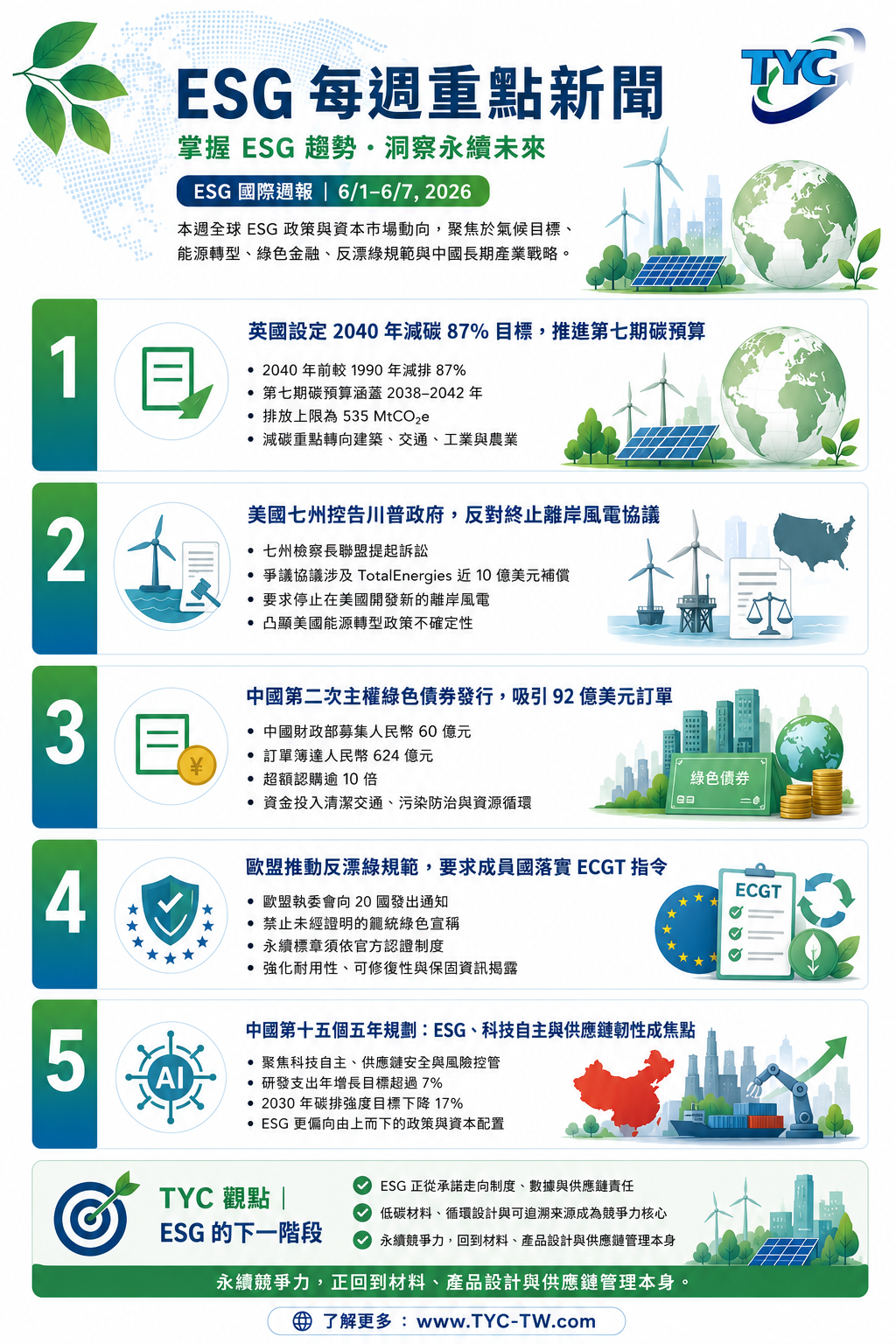
1. UK Sets 2040 Target to Cut Emissions by 87%
The UK government has proposed its seventh carbon budget, setting a target to reduce economy-wide greenhouse gas emissions by 87% by 2040 compared with 1990 levels.
The seventh carbon budget covers the 2038–2042 period and sets an emissions cap of 535 MtCO₂e. By 2025, the UK had already reduced emissions by approximately 54% compared with 1990 levels, largely driven by renewable energy growth and the phase-out of coal in the power sector.
Looking ahead, the UK’s decarbonization focus will shift beyond energy supply toward buildings, transport, industry and agriculture, signaling a deeper transformation across the economy.
2. Seven U.S. States Sue Over Deal Halting Offshore Wind
A coalition of seven state Attorneys General, led by New York Attorney General Letitia James, has filed a federal lawsuit against the Trump administration over an agreement with TotalEnergies to halt new offshore wind development in the United States.
Under the disputed agreement, TotalEnergies would receive nearly $1 billion in lease fee reimbursement and redirect funds toward U.S. gas and power projects.
The lawsuit argues that the deal may have violated environmental review requirements, lease cancellation procedures and state coordination obligations. The case also highlights the growing policy uncertainty surrounding the U.S. energy transition.
For companies, changing energy policy can directly affect renewable power procurement, Scope 2 emissions strategies and long-term decarbonization investment decisions.
3. China’s New Green Bond Offering Draws $9.2 Billion Order Book
China’s Ministry of Finance has completed its second sovereign green bond offering, raising RMB 6 billion, or approximately USD $887 million. Investor demand was strong, with the order book reaching RMB 62.4 billion, or about USD $9.2 billion, making the issuance more than 10 times oversubscribed.
Proceeds will support eligible green expenditures, including clean transportation, pollution prevention and control, resource utilization and recycling, sustainable water management, and marine ecosystem protection and restoration.
The strong demand reflects the growing role of green finance in global capital allocation. It also shows how circular economy, pollution control and low-carbon infrastructure are increasingly becoming financeable investment themes.
4. EU Pushes Member States to Implement Anti-Greenwashing Rules
The European Commission has sent formal notice letters to 20 EU member states, urging them to complete the transposition of the Directive on Empowering Consumers for the Green Transition into national law.
The directive restricts unverified generic environmental claims such as “eco-friendly” or “biodegradable,” and requires sustainability labels to be based on official certification schemes or standards established by public authorities.
The rules also strengthen disclosure around product durability, repairability and guarantee information. This means companies can no longer rely on broad sustainability narratives alone. Environmental claims must be supported by data, certifications and verifiable product information.
5. China’s 15th Five-Year Plan Reshapes the ESG and Investment Outlook
China’s 15th Five-Year Plan for 2026–2030 sends a clear signal that the country is shifting from high-speed growth toward technological self-reliance, supply chain security, energy resilience and systemic risk control.
The plan targets annual R&D spending growth above 7%, while lowering official GDP growth expectations to 4.5%–5%. This reflects a strategic focus on long-term technological competitiveness and industrial security.
From an ESG perspective, China’s model differs from Western voluntary disclosure frameworks. ESG integration is increasingly driven through top-down industrial policy, local government performance metrics, state capital allocation and national planning.
Environmental goals include a 17% reduction in carbon intensity by 2030, along with support for a national low-carbon transition fund, offshore wind, nuclear power and emerging green industries.
TYC Perspective|The Next Stage of ESG: Materials, Product Design and Supply Chain Management
Together, this week’s five ESG stories show that global sustainability is moving from public commitments toward systems, data and supply chain accountability.
For companies, the next stage of ESG is not only about reporting or brand reputation. It must be embedded in material selection, product design, production processes, carbon data and supply chain transparency.
For recycled plastics, circular materials and low-carbon building material industries, future competitiveness will depend on three core capabilities.
First, companies need verifiable carbon reduction data to help customers respond to carbon inventories, product carbon footprints and Scope 3 reduction needs.
Second, businesses must build traceable sourcing and transparent supply chain systems to strengthen product credibility and reduce greenwashing risk.
Third, circular design and low-carbon material applications must be considered from the product development stage, enabling reuse, remanufacturing and resource circulation.
TYC will continue to support brands and industrial customers through recycled plastic material technology, product carbon footprint data, circular design and transparent supply chain solutions. By doing so, we help customers reduce emissions, enhance sustainability competitiveness and move toward the next stage of a low-carbon circular economy.
Learn more: www.TYC-TW.com