
NEWS & EVENTS

- Home
- News
- ESG Weekly News
- ESG International Weekly News 6/15-6/21
ESG International Weekly News 6/15-6/21
June 23,2026
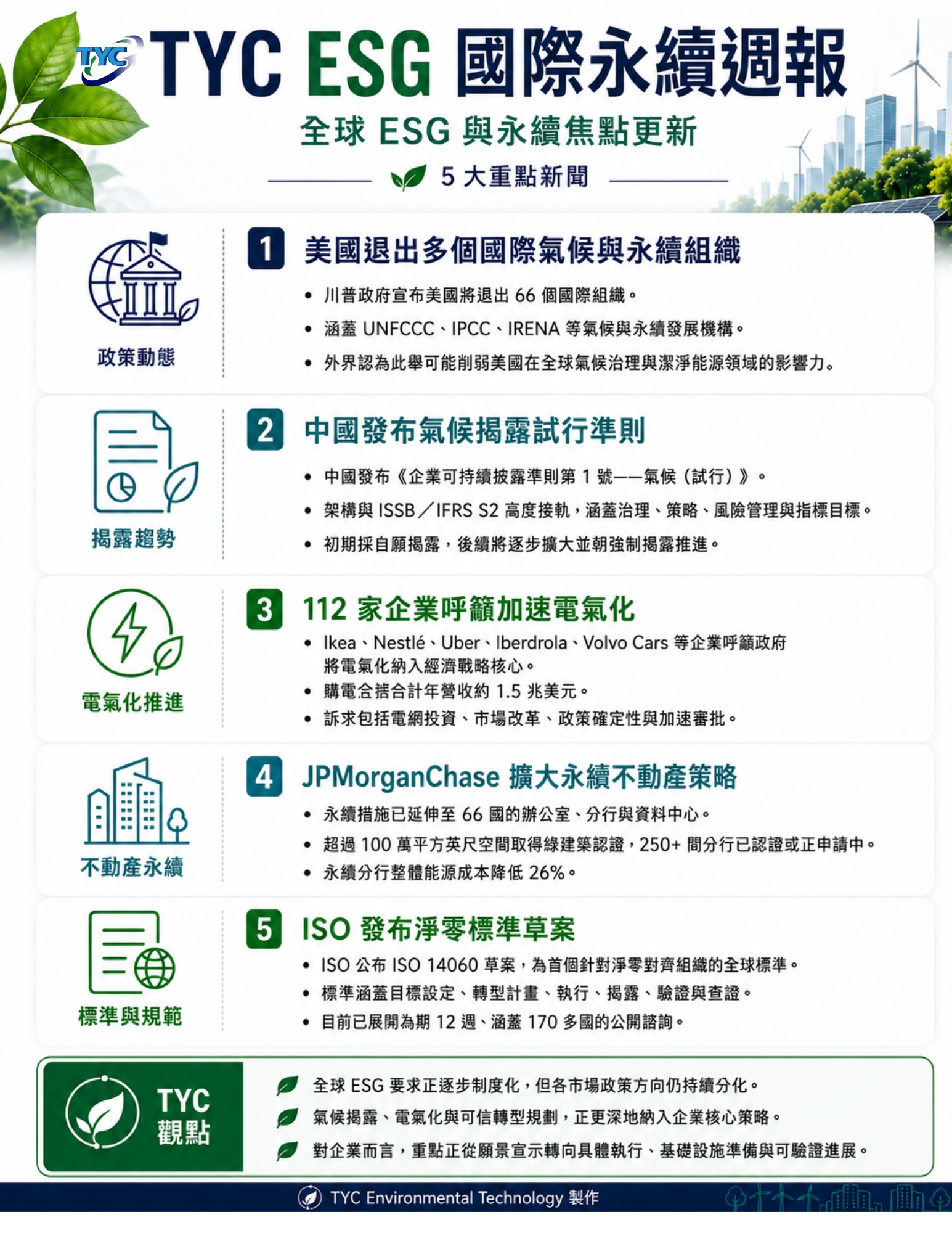
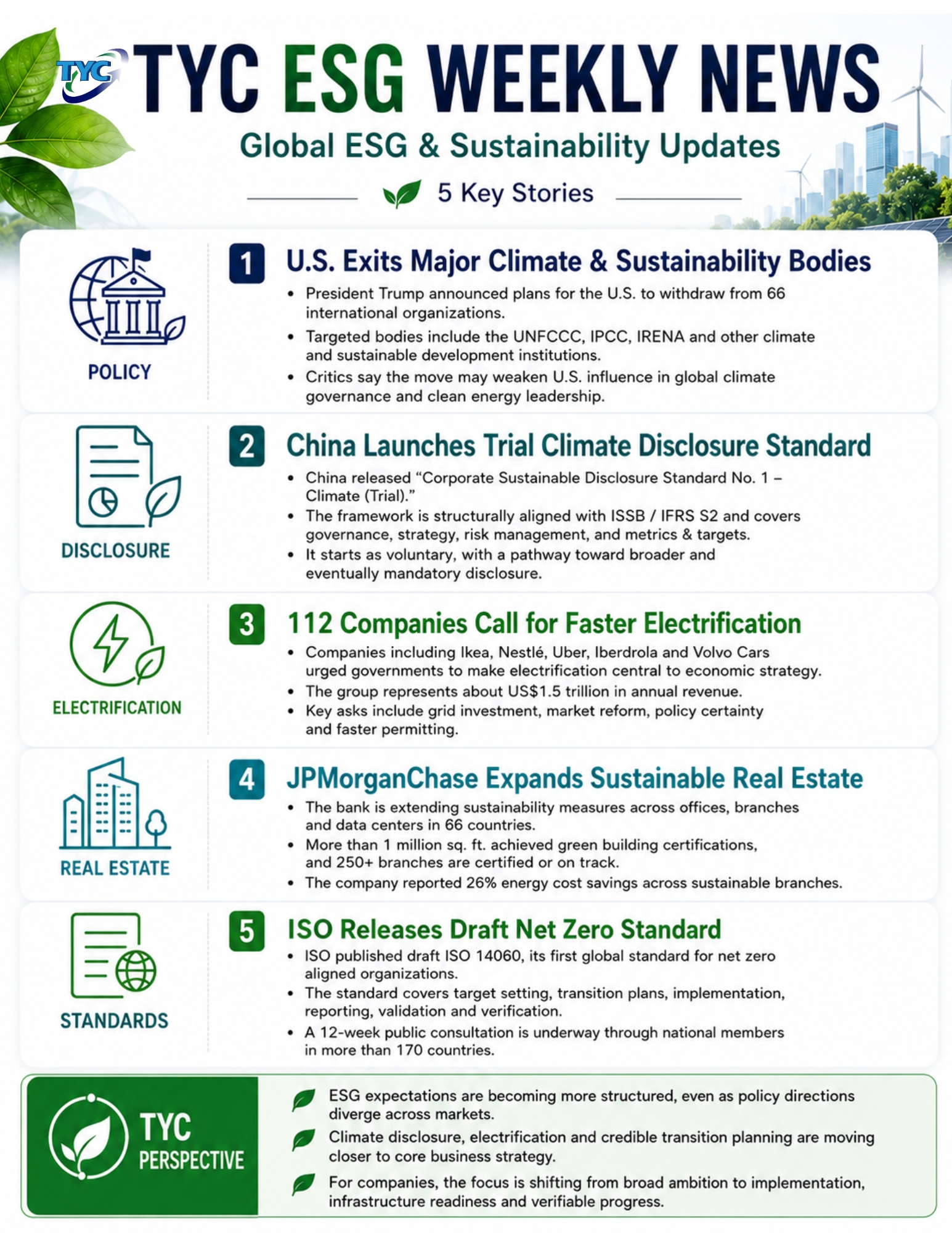
TYC ESG Weekly News|Global ESG & Sustainability Updates
This week’s ESG developments show a widening gap between global policy directions and corporate implementation needs. While the U.S. is stepping back from several international climate and sustainability organizations, China is moving toward more structured climate disclosure. At the same time, major global companies are calling for faster electrification, financial institutions are embedding sustainability into real estate operations, and ISO is advancing a new global framework for credible net zero transition plans.
1. U.S. Exits Major International Climate and Sustainability Organizations
The U.S. government announced plans to withdraw from 66 international organizations related to climate, clean energy, sustainable development, and global cooperation, including the UNFCCC, IPCC, and IRENA.
If completed, the withdrawal from the UNFCCC would mark a significant shift in global climate governance, as the UNFCCC is the foundational treaty behind both the Kyoto Protocol and the Paris Agreement. Critics argue that the move may reduce U.S. influence in international climate negotiations and weaken its role in clean energy leadership.
This development also reflects a broader divergence in climate policy direction among major economies, with some countries scaling back multilateral climate engagement while others continue strengthening climate-related regulations and disclosure systems.
2. China Releases Trial Corporate Climate Reporting Standard
China’s Ministry of Finance, together with other ministries, regulators, and the central bank, released the “Corporate Sustainable Disclosure Standard No. 1 – Climate (Trial).” The standard is designed to help companies disclose climate-related risks, opportunities, and impacts.
The new framework is structurally aligned with the ISSB’s IFRS S2 climate disclosure standard, covering governance, strategy, risk and opportunity management, and metrics and targets. However, it also includes China-specific adaptations, including disclosure of climate-related impacts from business activities and value chain operations.
The standard will initially be voluntary, but China plans to expand its application over time, moving from listed companies to non-listed companies, from large enterprises to SMEs, and eventually from voluntary disclosure toward mandatory climate-related disclosure.
3. 112 Global Companies Urge Governments to Accelerate Electrification
A group of 112 global companies, including Ikea, Nestlé, Uber, Iberdrola, Volvo Cars, Nikon, Levi Strauss, and H&M, called on governments to make electrification a central part of national economic strategy.
Together, the companies represent approximately US$1.5 trillion in annual revenue. Their message highlights that dependence on fossil fuels is not only a climate concern, but also a business risk affecting energy costs, supply chains, competitiveness, and investment planning.
The companies called for clearer policy frameworks, faster permitting, electricity market reform, grid modernization, and greater investment in renewable power and transmission infrastructure. The statement reflects how electrification is moving from sustainability departments into finance, procurement, operations, and risk management.
4. JPMorganChase Expands Sustainable Real Estate Strategy
JPMorganChase is expanding sustainability measures across its global real estate portfolio, including offices, branches, and data centers in 66 countries.
In 2024, more than 1 million square feet of the company’s real estate achieved green building certifications. More than 250 Chase branches are now certified or on track for third-party sustainability certification, and the company reported a 26% reduction in energy costs across its sustainable branch network.
The company is also applying sustainability principles to data centers by consolidating operations, migrating workloads to more efficient facilities, and optimizing energy and water use. The strategy shows how sustainable infrastructure can support cost efficiency, employee well-being, operational resilience, and emissions reduction.
5. ISO Releases Draft Net Zero Standard
The International Organization for Standardization released the draft ISO Net Zero Aligned Organizations Standard, ISO 14060. This is ISO’s first global standard designed to help companies and organizations develop credible net zero transition plans.
The draft standard covers target setting, transition planning, implementation, reporting, validation, and verification. It emphasizes deep greenhouse gas emissions reductions within an organization’s own inventory boundary and value chain, including Scope 1, Scope 2, and Scope 3 emissions.
The standard also addresses carbon credits, carbon removals, and the counterbalancing of residual emissions, while prioritizing direct emissions reduction. ISO has opened a 12-week public consultation period through national members in more than 170 countries.
TYC Perspective
This week’s news shows that ESG is becoming more structured, even as policy directions diverge across markets. The U.S. is reducing its role in global climate governance, while China is strengthening climate disclosure infrastructure. At the same time, businesses are pushing governments to accelerate electrification and provide clearer investment conditions.
For companies, ESG is increasingly shifting from broad commitments to practical implementation. Climate disclosure, electrification, sustainable buildings, data center efficiency, and credible transition planning are becoming part of core business strategy.
TYC believes companies should focus on measurable progress, transparent data, and practical low-carbon solutions. As disclosure expectations become more detailed, businesses will need stronger evidence, clearer product claims, and more reliable supply chain information to support their sustainability strategies.