
NEWS & EVENTS

- Home
- News
- ESG Weekly News
- Resource Circulation Promotion Act: Taiwan’s Circular Economy Enters a New Phase | TYC Environmental Technology
Resource Circulation Promotion Act: Taiwan’s Circular Economy Enters a New Phase | TYC Environmental Technology
June 04,2026
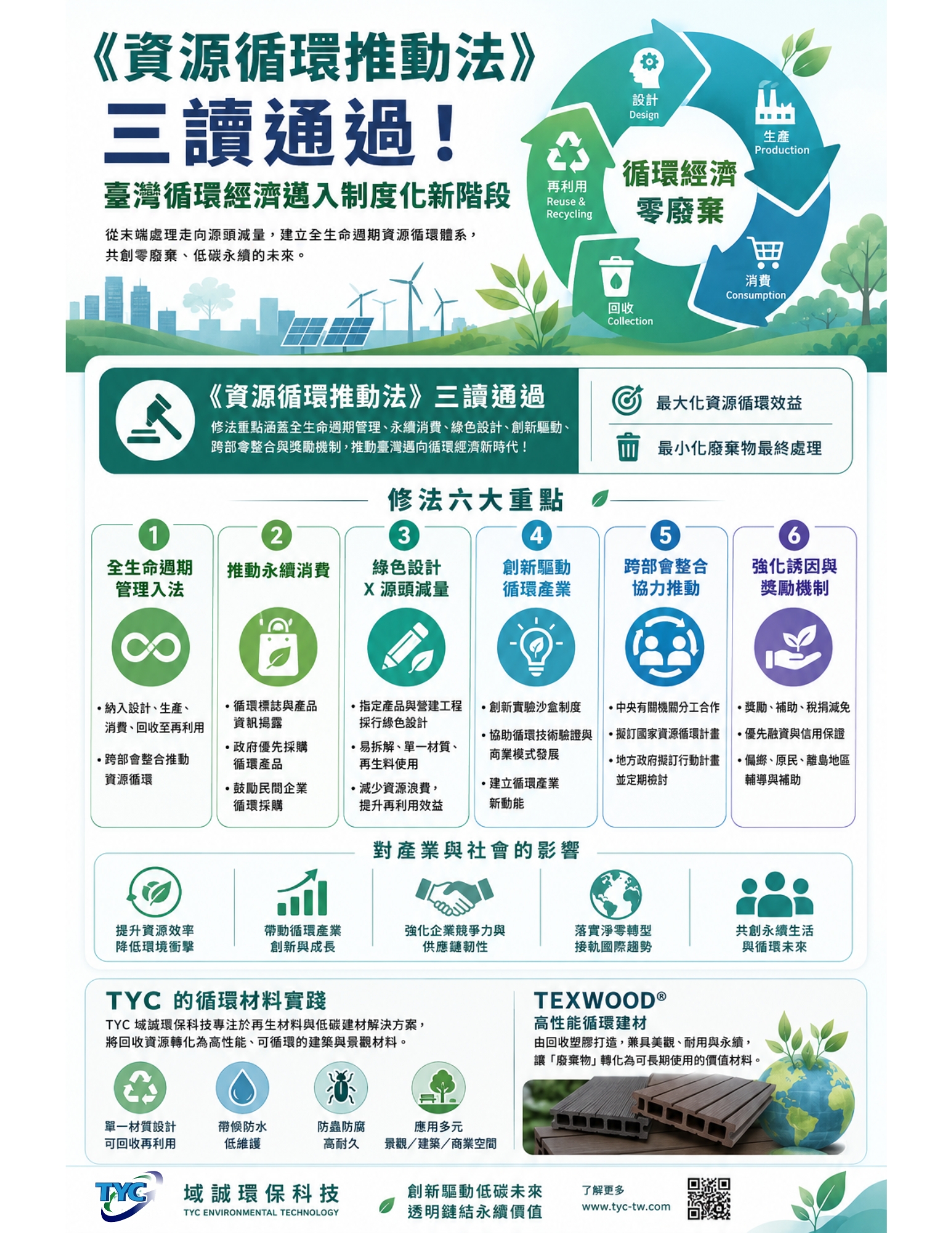
The Resource Circulation Promotion Act Passes Third Reading: Taiwan’s Circular Economy Enters a New Institutional Phase
Taiwan has reached an important milestone in resource governance. The amendment draft of the Resource Recycling and Reuse Act, proposed by the Ministry of Environment, has officially passed the third reading at the Legislative Yuan and has been renamed the Resource Circulation Promotion Act. This legislation marks a significant shift in Taiwan’s resource management approach, moving from a traditional focus on end-of-pipe treatment toward an integrated governance framework centered on source reduction, circular design, and resource reuse.
For the circular materials and low-carbon building materials industries, this is not only a policy update, but also a signal that Taiwan’s circular economy is entering a new stage of institutional development.
From End-of-Pipe Treatment to Life Cycle Management
In the past, waste management primarily focused on recycling, collection, transportation, and final disposal. However, amid the global transition toward net-zero emissions and increasing resource constraints, every stage of a product’s life cycle — from design, production, and consumption to recycling and reuse — has become essential to improving resource efficiency and reducing environmental impact.
The Resource Circulation Promotion Act incorporates life cycle management into the legal framework and promotes cross-ministerial collaboration to implement resource circulation policies across different industries. This means that future product and material design will place greater emphasis on disassembly, mono-material structures, the use of recycled materials, and the feasibility of downstream recycling and reuse.
Green Procurement and Product Disclosure Drive Sustainable Consumption
The amendment also strengthens the promotion of sustainable consumption and circular procurement, including circular labeling, product information disclosure, government priority procurement of circular products, and encouragement for private enterprises to adopt circular products.
These policy tools will help increase market confidence in recycled materials and circular products, while further driving demand for green procurement. As information on material sources, circular features, and environmental performance becomes more transparent, companies will be able to better evaluate the sustainability value of products in procurement and supply chain management.
Green Design and Recycled Materials as Future Industrial Competitiveness
Under the new legal framework, designated products and construction projects will be encouraged or required to adopt green design principles. These include reducing resource waste, improving reuse efficiency, using recycled materials, and applying product structures that are more suitable for recycling.
For the building materials and manufacturing industries, circular design will no longer be merely an added value, but a key foundation for future product competitiveness. Whether a material can be recycled, whether it provides stable performance, and whether it can help reduce carbon emissions will increasingly become central concerns for both the market and policy development.
TYC’s Circular Materials Practice
TYC Environmental Technology has long focused on recycled plastic materials, high-performance circular building materials, and low-carbon material solutions. The company is committed to transforming recycled plastics into practical, high-value materials and building products.
Taking TEXWOOD® as an example, it adopts a mono-material design and offers recyclability, weather resistance, water resistance, termite resistance, and low-maintenance advantages. It can be applied in outdoor building materials, landscape structures, and commercial spaces. Through material design and application integration, TYC continues to promote the transformation of recycled resources from “waste” into durable, high-performance materials.
Building a More Resilient Circular Supply Chain
The passage of the Resource Circulation Promotion Act provides a clearer policy direction for Taiwan’s circular economy and creates more development opportunities for recycled materials, circular building materials, and low-carbon products.
Guided by the vision of “Innovation Drives a Low-Carbon Future, Transparency Connects Sustainable Value,” TYC will continue to advance circular material technologies, product carbon transparency, and sustainable applications. Through these efforts, TYC aims to support companies in reducing resource dependence and carbon emissions, while working together to build a more resilient circular industrial supply chain.
#ResourceCirculationPromotionAct #CircularEconomy #RecycledMaterials #LowCarbonBuildingMaterials #SustainableBuildingMaterials #CircularDesign #SourceReduction #NetZeroTransition #TYCEnvironmentalTechnology #TEXWOOD
News Source: Ministry of Environment News Center