
NEWS & EVENTS

- Home
- News
- ESG Weekly News
- ESG International Weekly News 5/11-5/17
ESG International Weekly News 5/11-5/17
May 19,2026
ESG International Weekly News|May 11–May 17
From Carbon Market Standards to Circular Materials: Global ESG Transformation Moves Into Supply Chains and Industrial Practice
This week’s international ESG policy and market updates show that sustainability is moving beyond voluntary corporate commitments and into policy frameworks, capital allocation, material innovation, and supply-chain execution. From the EU, China, and Brazil launching a carbon market coalition, to Google expanding renewable energy procurement in Texas and Target integrating recycled polyester into product categories, ESG is becoming a core business factor that directly affects investment decisions, operating costs, supply-chain strategy, and product design.
For manufacturers, brand owners, and material suppliers, future competitiveness will increasingly depend on the ability to provide low-carbon, recyclable, traceable, and scalable solutions.
1. EU, China and Brazil Launch Carbon Market Coalition to Raise Global Pricing Standards
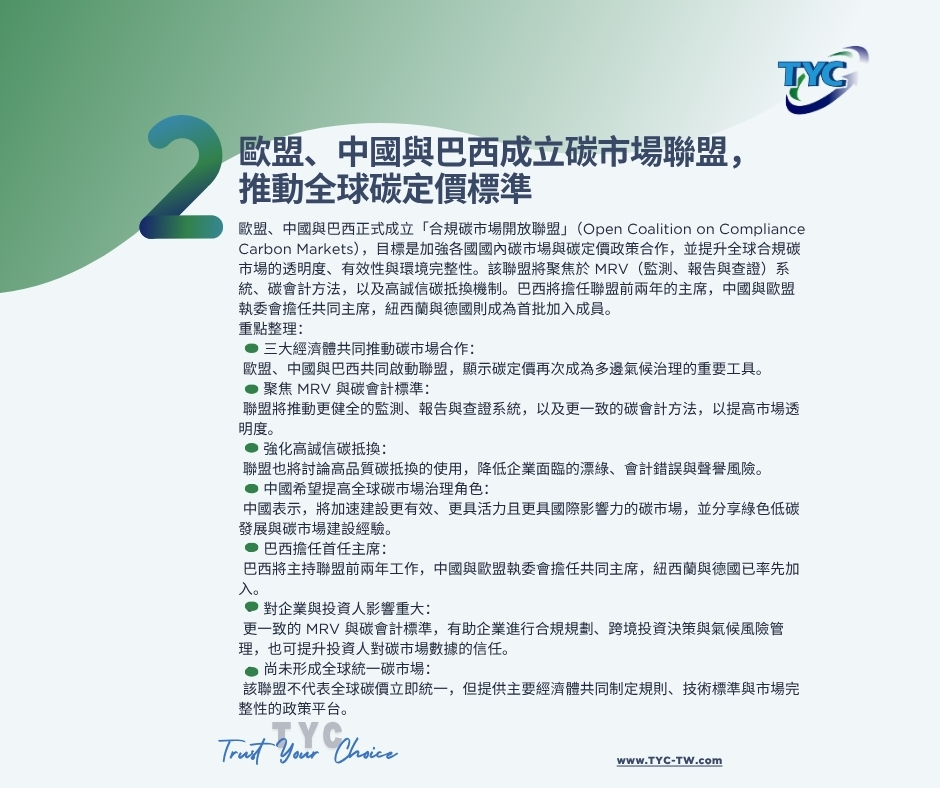
The European Union, China, and Brazil have launched the Open Coalition on Compliance Carbon Markets, aiming to strengthen cooperation on domestic carbon markets and carbon pricing policies while improving the transparency, effectiveness, and environmental integrity of global compliance carbon markets.
The coalition will focus on MRV systems — monitoring, reporting, and verification — carbon accounting methods, and high-integrity offsets. Brazil will chair the coalition for the first two years, while China and the European Commission will serve as co-chairs. New Zealand and Germany are the first countries to join as members.
Although the coalition does not create a unified global carbon market or immediately harmonize carbon prices, it establishes a new policy platform where major economies can discuss carbon market rules, technical standards, and market integrity. For companies operating across borders, carbon costs, carbon accounting, and consistent compliance data will become increasingly important.
2. Google Signs 500MW Texas Solar Deal to Support Data Center Growth
Google has signed a 15-year power purchase agreement with renewable energy developer Linea Energy for 500MW of solar power from the Duffy Solar Project in Matagorda County, Texas. The electricity will support Google’s data center operations within the ERCOT market.
The project is expected to begin construction in the third quarter of 2026 and will be co-located with Linea’s 235MWac Duffy battery storage project, which is already under construction. As AI, cloud services, and data center electricity demand continue to rise, technology companies are increasingly using long-term renewable energy procurement to balance operational reliability, electricity cost visibility, and climate commitments.
This also shows that corporate energy strategy is evolving. Renewable energy procurement is no longer only a decarbonization tool; it is closely connected to grid capacity, battery storage, power price stability, and regional infrastructure resilience.
3. Chinese Clean Tech Firms Pull Back From U.S. Manufacturing as Policy Risk Rises
Chinese clean technology companies are reducing their U.S. manufacturing exposure as tax policy changes, geopolitical pressure, and compliance risks reshape the investment case. According to Rhodium Group, China-based clean tech companies canceled around $2.8 billion in planned U.S. manufacturing investments in 2025. By the end of March, more than half of proposed Chinese clean tech investments in the U.S. announced since 2022 had been canceled, paused, or delayed.
Jinko Solar’s sale of about a 75% stake in its Florida solar panel facility is the latest example of Chinese solar, battery, and EV companies reducing exposure to the U.S. market. New rules targeting “foreign entities of concern” under U.S. tax policy could limit China-linked companies’ access to manufacturing tax credits, directly affecting the economics of factory investment.
This trend reminds investors and companies that clean tech investment is no longer driven only by demand, production cost, or customer access. Policy eligibility, supply-chain origin, ownership structure, and geopolitical exposure have become critical factors in capital allocation.
4. Target and Syre Partner to Scale Circular Materials in Products
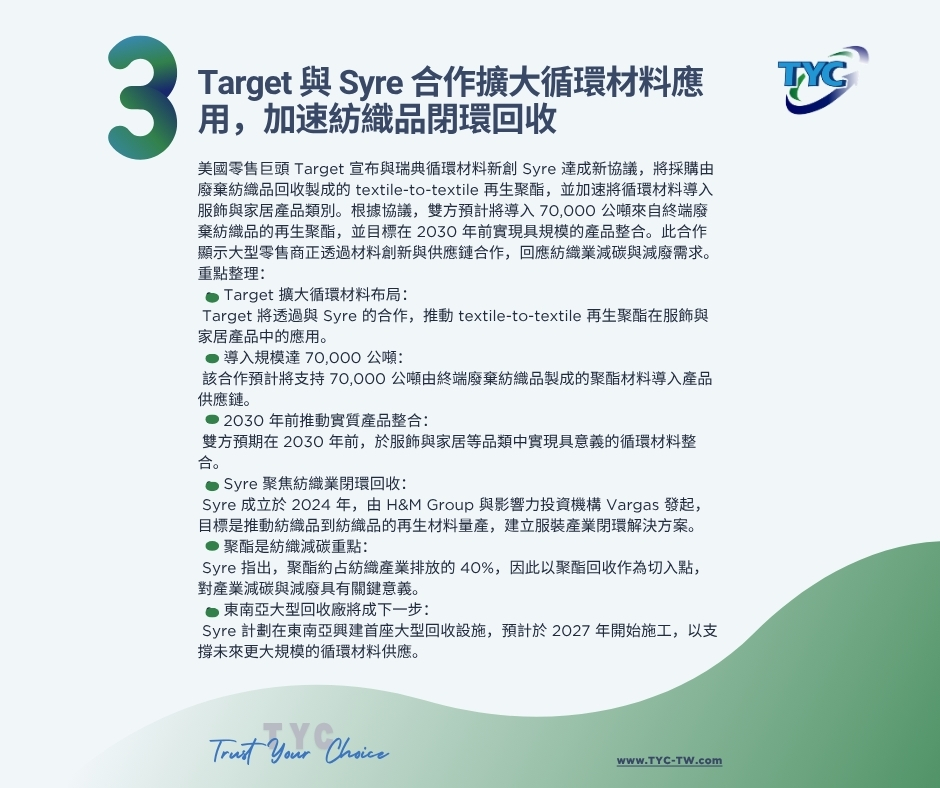
Target has signed a new agreement with Sweden-based circular materials startup Syre to source textile-to-textile recycled polyester and accelerate the integration of circular materials across apparel and home product categories.
The partnership is expected to support the use of 70,000 metric tons of polyester made from end-of-life textiles, with meaningful product integration targeted by 2030. Founded in 2024 by H&M Group and impact-focused investor Vargas, Syre aims to mass-produce textile-to-textile recycled materials and build a closed-loop solution for the fashion industry.
This partnership shows that major retailers and brands are bringing circular materials into product design and supply-chain strategy. For the textile, plastics, and packaging industries, the ability to provide recyclable materials, stable supply, and Scope 3 reduction benefits will become increasingly important to market competitiveness.
5. EU ETS Update Proposes More Free Allowance Value for Industry
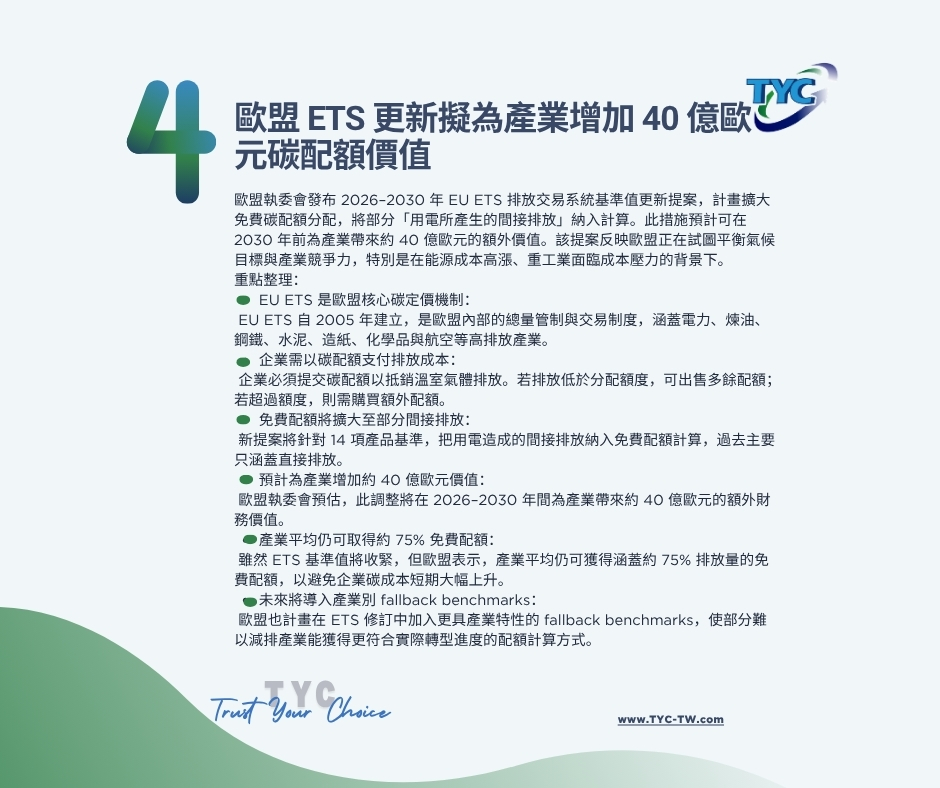
The European Commission has proposed updated EU Emissions Trading System benchmark values for 2026–2030, including measures to expand free allowance allocation to cover certain indirect emissions from electricity use. The Commission expects this update to provide around €4 billion in additional value to industry through 2030.
The EU ETS is the European Union’s core carbon pricing mechanism. Since its launch in 2005, it has covered emissions-intensive sectors such as electricity, refining, steel, cement, paper, chemicals, and aviation. Companies must surrender carbon allowances to cover greenhouse gas emissions. Companies that emit less than their allocation can sell surplus allowances, while companies exceeding their allocation must buy additional permits.
This update reflects the EU’s effort to balance climate ambition with industrial competitiveness. While the ETS remains a key tool for driving decarbonization, the EU is also using regulatory flexibility to ease short-term carbon compliance pressure on industry amid high energy costs and global competitiveness concerns.
TYC Perspective|The Next Stage of ESG Starts With Materials, Energy, and Supply-Chain Management
This week’s five updates point to one clear direction: ESG is moving from reporting and commitments into real decisions around materials, energy procurement, carbon costs, and supply-chain compliance.
The carbon market coalition highlights the need for stronger MRV and carbon accounting standards. Google’s solar deal shows that energy sourcing is now part of corporate operating strategy. The pullback of Chinese clean tech investment from the U.S. reminds companies that policy risk and supply-chain structure can directly affect capital decisions. Target and Syre’s partnership shows that circular materials are moving from concept to large-scale product integration. The EU ETS update reflects how carbon costs are becoming a key factor in industrial competitiveness.
For manufacturers, brand owners, and building material suppliers, future sustainability competitiveness will depend on three core capabilities:
- Providing low-carbon, recyclable, and stable-supply materials
- Quantifying product carbon footprints and Scope 3 reduction benefits
- Building transparent, traceable, and verifiable supply-chain data
TYC continues to focus on circular materials, recycled plastics, low-carbon product development, and carbon footprint management. We help companies integrate recycled materials into products, construction, and packaging applications. As global ESG rules become more structured and data-driven, materials are no longer just production inputs — they are the starting point for decarbonization, compliance, and long-term competitiveness.
Learn more:
www.TYC-TW.com