
NEWS & EVENTS

- Home
- News
- ESG Weekly News
- ESG International Weekly News 5/4-5/10
ESG International Weekly News 5/4-5/10
May 13,2026
ESG International Weekly News | May 4–May 10
From Climate Disclosure to Packaging Compliance: Global ESG Rules Are Becoming More Measurable and Supply-Chain Driven
This week’s ESG and climate policy developments show a clear direction: sustainability is moving from voluntary commitments toward structured compliance, measurable data, and supply-chain accountability.
From China’s new climate disclosure standard and Southeast Asia’s Article 6 carbon credit cooperation, to the EU’s evolving carbon market and packaging regulations, global ESG rules are becoming more focused on transparency, verification, and practical implementation.
For companies, ESG is no longer only about reporting or brand positioning. It is increasingly tied to market access, supply-chain management, material selection, carbon costs, and long-term competitiveness.
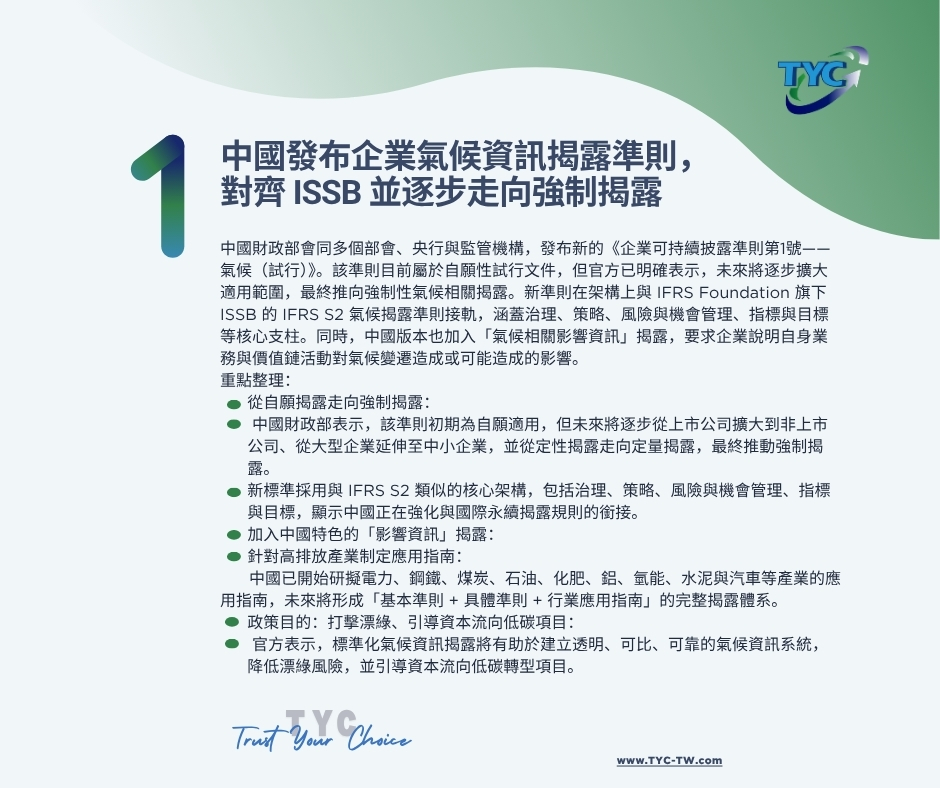
1. China Releases Corporate Climate Reporting Standard Aligned with ISSB
China’s Ministry of Finance, together with other ministries, the central bank, and regulators, released the new Corporate Sustainable Disclosure Standard No. 1 – Climate (Trial). The standard is currently voluntary, but Chinese authorities have indicated that it will gradually expand in scope and eventually move toward mandatory climate-related disclosure.
The new framework is structurally aligned with the IFRS Foundation’s ISSB climate reporting standard, IFRS S2. It includes key pillars such as governance, strategy, risk and opportunity management, and metrics and targets. A China-specific addition is the requirement to report climate-related impact information, including how business and value chain activities affect, or may foreseeably affect, climate change.
This marks an important step in China’s effort to build a more transparent, comparable, and reliable climate disclosure system.
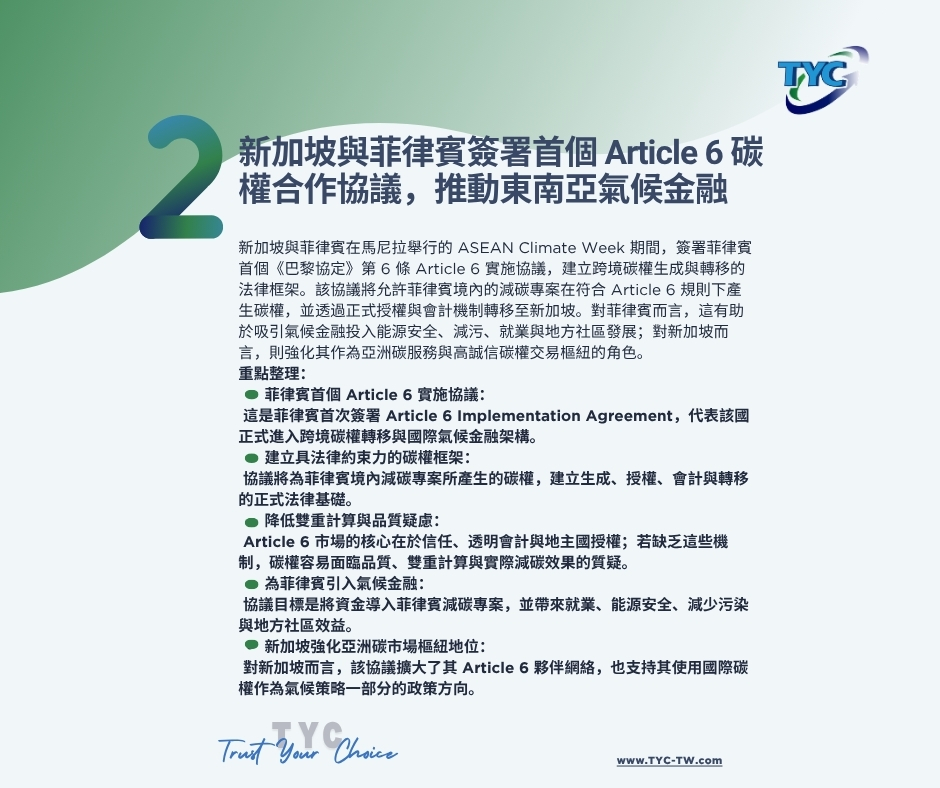
2. Singapore and the Philippines Sign First Article 6 Carbon Credits Deal
Singapore and the Philippines signed the Philippines’ first Article 6 Implementation Agreement during ASEAN Climate Week in Manila. The agreement establishes a legal framework for generating and transferring carbon credits from mitigation projects in the Philippines under the Paris Agreement.
For the Philippines, the agreement creates a pathway to attract climate finance into emissions reduction projects that can also support energy security, pollution reduction, job creation, and local communities. For Singapore, it expands its Article 6 partnership network and strengthens its role as a regional carbon services hub.
The deal also signals that Southeast Asia’s carbon market is moving from concept to execution, with clearer legal, accounting, and authorization structures for cross-border carbon credit transfers.
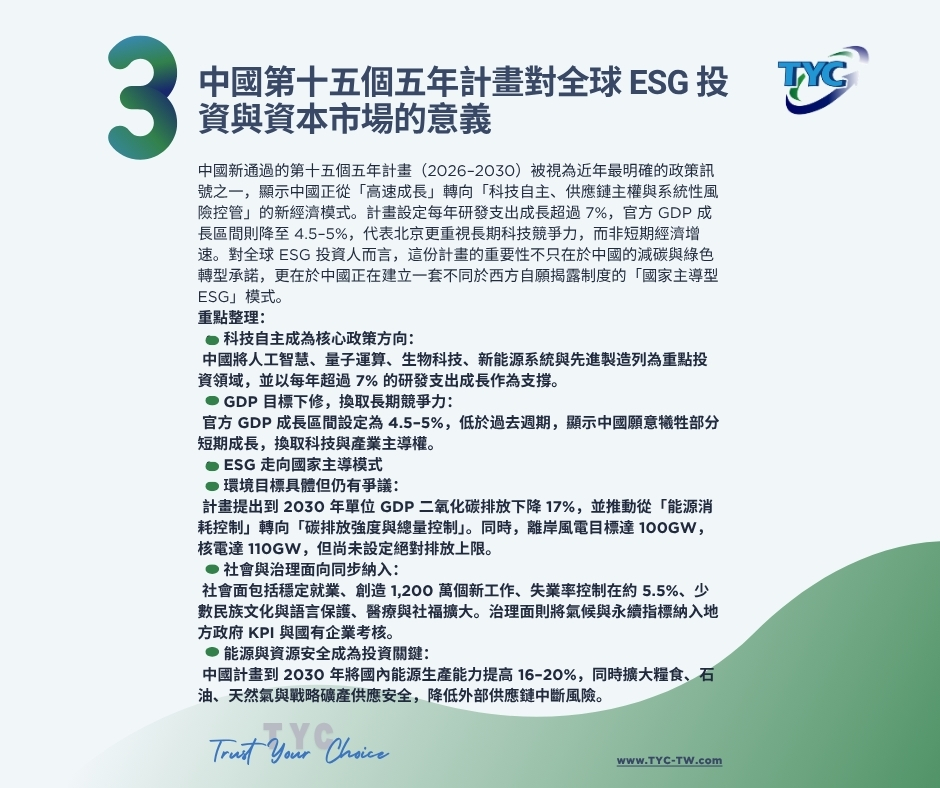
3. China’s 15th Five-Year Plan Signals Tech Sovereignty and State-Led ESG
China’s 15th Five-Year Plan for 2026–2030 is one of Beijing’s clearest policy signals in recent years. It shows a shift away from high-speed growth and toward technological self-reliance, supply-chain security, and systemic risk control.
The plan targets annual R&D spending growth above 7%, while lowering official GDP growth expectations to 4.5–5%. This suggests that Beijing is prioritizing long-term technological competitiveness over short-term economic expansion. Key focus areas include artificial intelligence, quantum computing, biotechnology, new energy systems, and advanced manufacturing.
On ESG, China is developing a state-led model that differs from Western voluntary disclosure frameworks. Climate and sustainability metrics are being integrated into local government KPIs, state-owned enterprise mandates, and industrial policy. Environmental targets include a 17% reduction in carbon dioxide emissions per unit of GDP by 2030, along with 100GW of offshore wind and 110GW of nuclear capacity targets.
For global investors, this means traditional ESG scoring tools may not fully capture China’s ESG risks and opportunities, especially as sustainability becomes closely linked with industrial strategy, energy security, and supply-chain resilience.
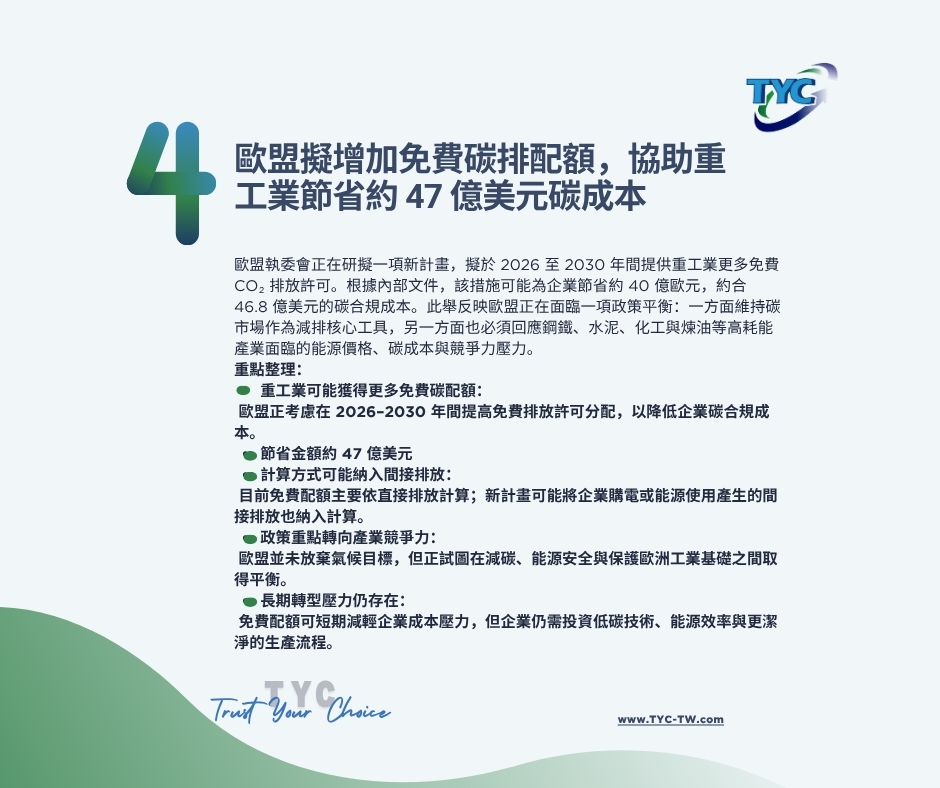
4. EU Plan Could Save Heavy Industry $4.7 Billion in Carbon Costs
The European Commission is drafting a plan to provide heavy industry with more free CO₂ permits from 2026 to 2030. According to an internal document, the proposal could save companies around €4 billion, or about $4.68 billion, in carbon compliance costs.
The proposal reflects a difficult policy balance for the EU. Its Emissions Trading System remains a central tool for cutting industrial emissions, but heavy manufacturers in sectors such as steel, cement, chemicals, and refining are facing pressure from high energy prices, carbon costs, and weak demand.
The draft plan may include indirect emissions, such as those from purchased electricity, when calculating free permit allocations. More free permits could ease short-term cost pressure for industry, but companies will still need to invest in cleaner production, energy efficiency, and low-carbon technologies to manage long-term transition risk.
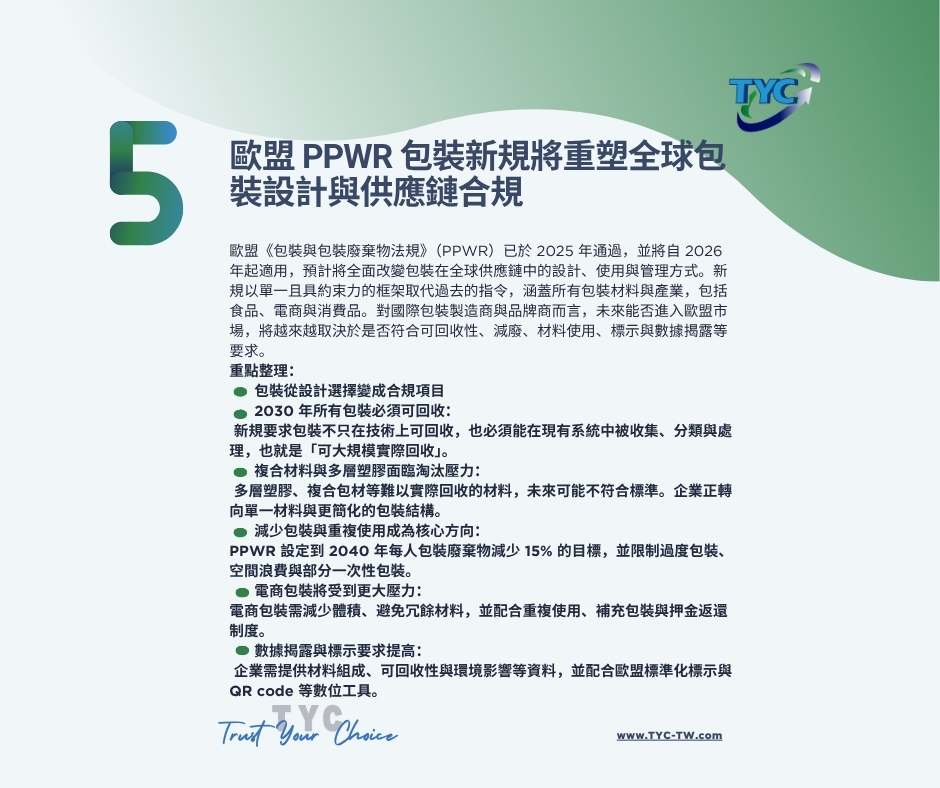
5. EU PPWR Packaging Rules Are Reshaping Global Packaging Compliance
The EU Packaging and Packaging Waste Regulation, or PPWR, was adopted in 2025 and will apply from 2026. It is expected to reshape how packaging is designed, used, and managed across global supply chains.
Under the new rules, all packaging must be recyclable by 2030. This goes beyond technical recyclability. Packaging must be recyclable at scale, meaning it can be collected, sorted, and processed through existing systems. This requirement is expected to place pressure on complex materials such as multi-layer plastics and composites.
The PPWR also targets a 15% reduction in packaging waste per person by 2040 and restricts excessive packaging, empty space, and certain single-use formats. Companies will also need to provide clearer data on material composition, recyclability, and environmental impact, supported by standardized labeling and digital tools such as QR codes.
For international brands and packaging suppliers, EU rules are increasingly becoming a global benchmark. To access the European market, packaging will need to be simpler, more recyclable, lower in volume, and more transparent in data reporting.
TYC Perspective | The Next Stage of ESG Starts with Materials and Supply Chains
This week’s five ESG updates point to one clear trend: global sustainability rules are becoming more measurable, traceable, and verification-based.
Climate disclosure requires companies to explain risks, targets, and data. Carbon markets require higher integrity and stronger accounting. Carbon costs are reshaping industrial competitiveness. Packaging rules are directly affecting material design, recyclability, and reporting requirements.
For manufacturers, brand owners, and building material suppliers, sustainability can no longer remain only at the reporting level. It must be embedded into product design, material selection, supply-chain management, and carbon footprint data.
The next stage of business competitiveness will depend on three key capabilities:
- Providing low-carbon and recyclable materials
- Quantifying product carbon footprints and Scope 3 reduction benefits
- Building transparent, traceable, and verifiable supply-chain data
At TYC, we continue to focus on circular materials, recycled plastics, low-carbon product development, and carbon footprint management. Our goal is to help companies integrate recycled and low-carbon materials into products, construction, and packaging applications—turning sustainability goals into measurable and practical actions.
Learn more:
www.TYC-TW.com