
NEWS & EVENTS

- Home
- News
- ESG Weekly News
- ESG International Weekly News 4/7-4/13
ESG International Weekly News 4/7-4/13
April 14,2026

This Week in ESG: Low Carbon × Circular Economy × Data-Driven Impact Are Reshaping Competitiveness
This week’s ESG developments reinforced a clear message: sustainability is no longer just about brand image or compliance. It is increasingly becoming a core business logic that influences supply chains, capital allocation, energy strategy, and material decisions. From retail campaigns directly linking purchases to plastic recovery, to India’s steel decarbonization push, to rising scrutiny over water and energy use in AI data centers, and stronger investor appetite for circular economy funds in Asia, the pattern is clear: growth alone is no longer enough—companies are now expected to prove that growth is lower-carbon, more resource-efficient, and more traceable.
1. Retail is becoming a direct driver of circular outcomes
The Sephora × Saie campaign is a strong example of how ESG is moving closer to the transaction itself. By linking product purchases directly to plastic recovery, sustainability becomes visible and measurable in everyday commercial activity.
This matters because it signals a broader shift from corporate-level ESG commitments to transaction-level impact accountability. Going forward, customers, investors, and partners will increasingly expect brands to explain exactly how much waste is recovered, how much carbon is reduced, or how much environmental value is created per product sold. In that environment, verifiable environmental data becomes a competitive differentiator.
2. Heavy industry is entering an era of carbon competition
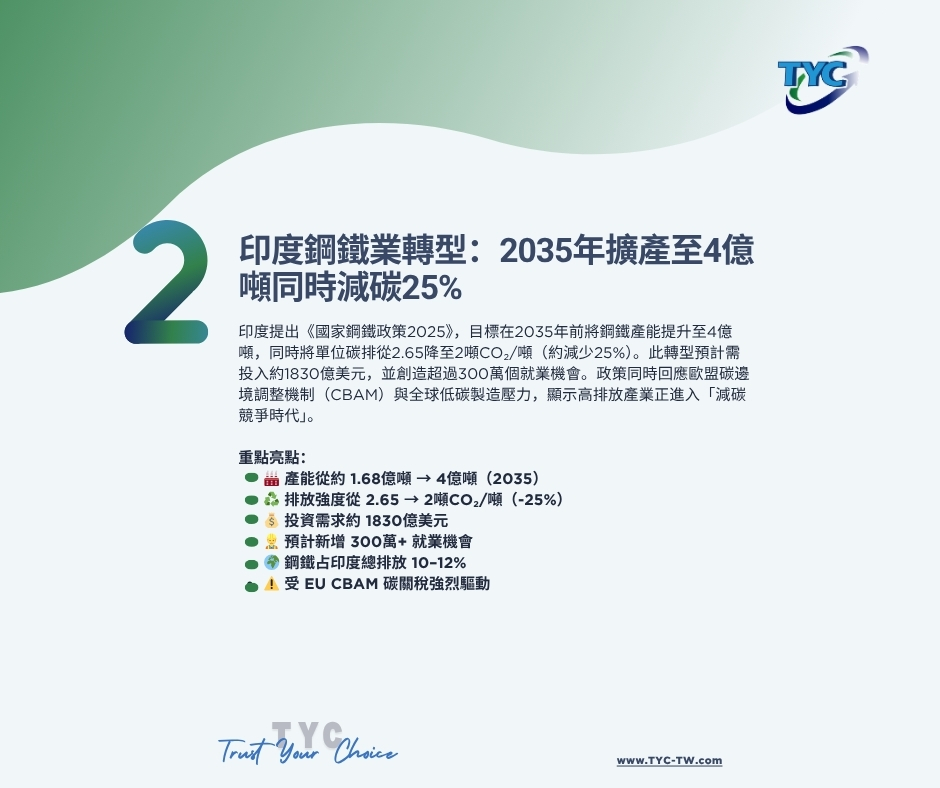
India’s new steel policy aims to expand production capacity to 400 million tons by 2035 while reducing emissions intensity from roughly 2.65 tons of CO₂ per ton of steel to 2 tons. This is more than a national industrial strategy—it is a sign that carbon-intensive sectors are entering a new phase of global competition.
With policies such as the EU’s CBAM reshaping trade conditions, competitive advantage will no longer depend only on cost and scale. It will also depend on carbon intensity. The ability to produce with lower emissions is becoming part of export readiness and long-term market access. For manufacturers, the signal is clear: decarbonization is no longer optional—it is part of the operating baseline.
3. The energy transition is moving from infrastructure to everyday use cases
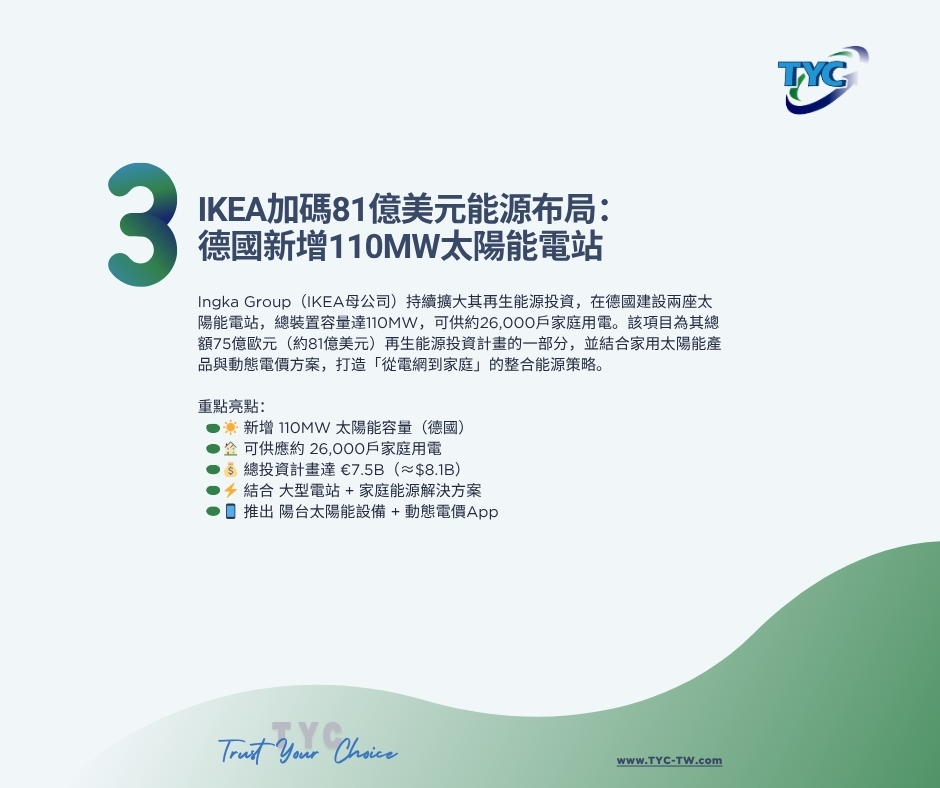
Ingka Group, IKEA’s parent company, is expanding large-scale renewable energy investments in Germany while also bringing energy transition solutions to households through residential solar offerings and dynamic pricing models. This reflects an important shift: the energy transition is no longer only about utility-scale generation. It is increasingly about how clean energy connects with homes, retail channels, and consumer behavior.
This suggests that future ESG strategies must go beyond internal energy procurement. Companies that can turn sustainability into a product, service, or daily-use experience will be better positioned in the next phase of market evolution. In other words, the integration of infrastructure and end-user application is becoming a new source of business innovation.
4. AI growth is making water and energy risk impossible to ignore
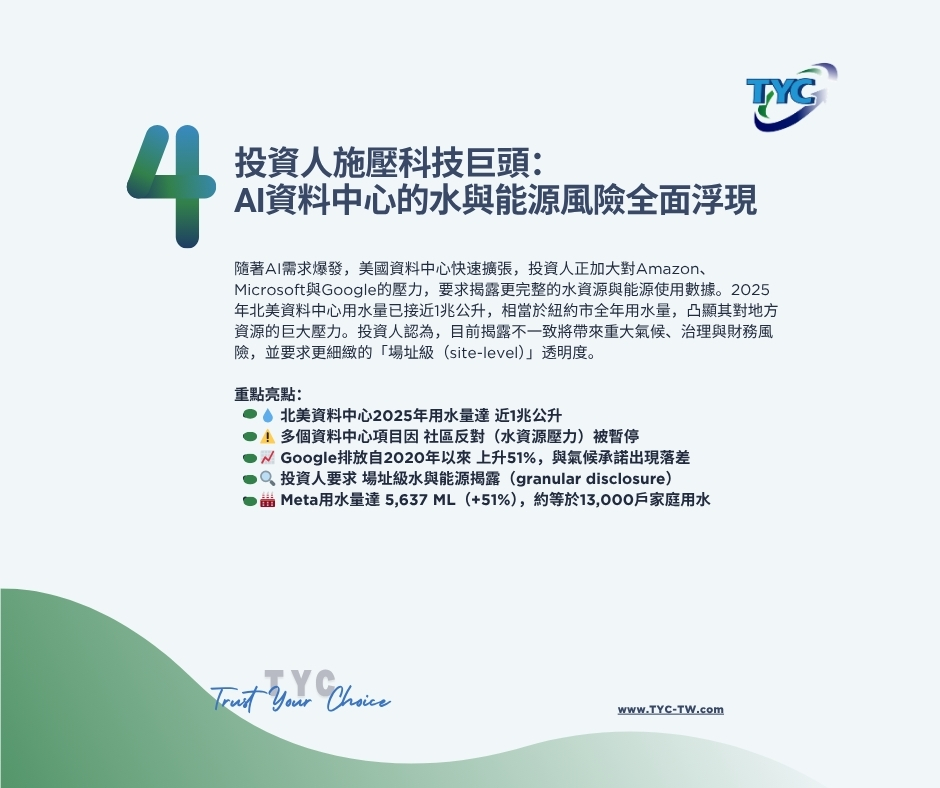
As AI demand accelerates, data centers have become one of the most important pieces of modern infrastructure. At the same time, their environmental footprint is attracting growing investor scrutiny. North American data centers consumed nearly 1 trillion liters of water in 2025, and major tech firms are facing increasing pressure to disclose more detailed water and energy usage data.
This reflects a broader change in ESG evaluation. Carbon remains critical, but investors and stakeholders are increasingly expanding the lens to include water intensity, energy efficiency, and site-level transparency. In the AI era, competitiveness is not just about computing power. It is also about resource productivity: who can deliver more performance with less carbon, less water, and less energy.
5. Circular economy is becoming a core investment thesis
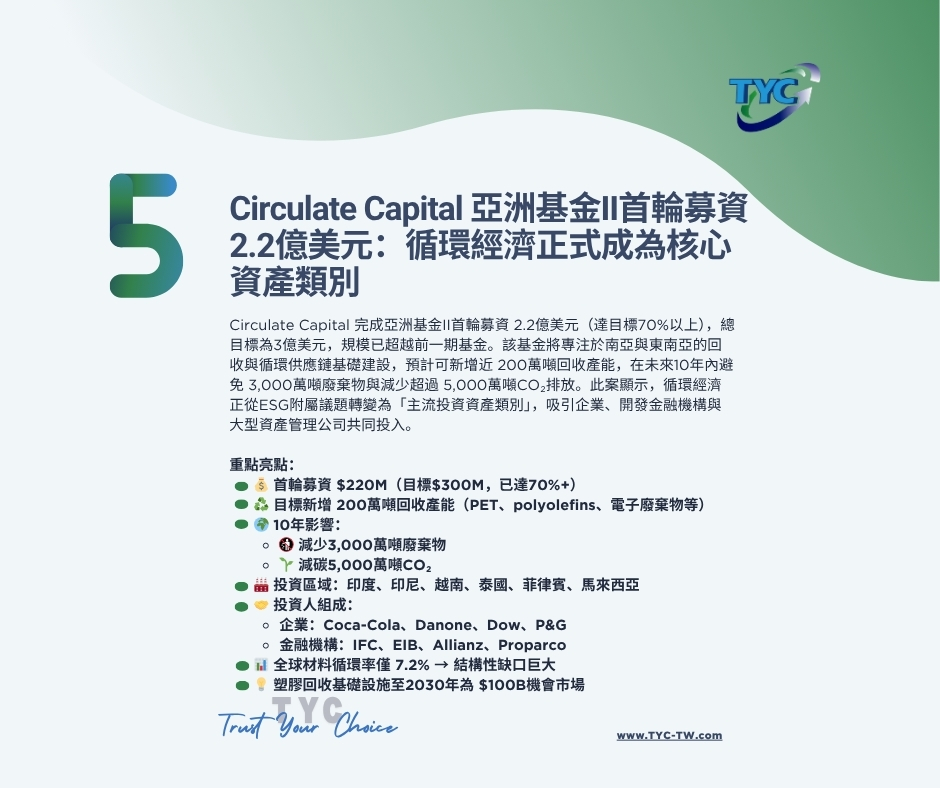
The first close of Circulate Capital Asia Fund II at $220 million shows that circular economy investing is no longer a niche ESG allocation. It is increasingly being treated as a scalable, infrastructure-like asset class with strong strategic relevance.
By targeting recycling and circular supply chains across South and Southeast Asia, the fund reflects a deeper structural shift: waste is being redefined as feedstock, and recycling capacity is being treated as industrial capacity. For both companies and investors, this means that secure PCR supply, traceability, impact measurement, and circular material systems are becoming central to long-term resilience and competitiveness.
TYC Perspective
Taken together, this week’s developments point to three important shifts:
1. ESG is becoming a measurable business language
The market is no longer satisfied with broad sustainability claims. It wants numbers: How much carbon was reduced? How much recycled content was used? How much resource efficiency was gained? Every ESG claim increasingly needs a data foundation.
2. Circular materials and traceable supply chains are rising in value
Across industries, companies are looking for low-carbon material solutions that are scalable, verifiable, and aligned with evolving regulations and customer expectations. This creates growing strategic value for PCR materials, recycled composites, and traceable supply networks.
3. The next real competitive edge is total resource efficiency
Future competitiveness will not be defined by carbon reduction alone. It will come from the ability to reduce carbon, optimize energy and water use, improve material efficiency, and build stronger supply chain resilience at the same time.
In this environment, TYC continues to focus on:
- Circular material solutions such as PCR applications and TEXWOOD
- Carbon data capability supported by product carbon footprint methodologies such as ISO 14067
- Supply chain traceability to strengthen transparency, credibility, and measurable environmental value
Quantify Your Carbon Reduction Opportunity
For companies looking to better understand the carbon impact of material choices, TYC also offers an online Carbon Calculator to help brands and manufacturers estimate the carbon reduction potential of different material strategies in a more practical and data-driven way.
Try the Carbon Calculator:
https://www.tyc-tw.com/carbon-calculator
Learn more:
https://www.tyc-tw.com