
NEWS & EVENTS

- Home
- News
- ESG Weekly News
- ESG International Weekly News 3/30-4/6
ESG International Weekly News 3/30-4/6
April 10,2026
🌍 Global ESG & Supply Chain Transformation: 5 Key Signals Shaping the Future (2026)
Across major economies, recent policy developments highlight a clear convergence: carbon management, circular materials, and digital infrastructure are rapidly becoming central to economic competitiveness.
From the U.S. and EU to China and Germany, governments are aligning around a shared objective:
👉 Strengthen supply chain resilience, reduce carbon dependency, and enhance strategic autonomy.
Below are five key global signals shaping this transition:
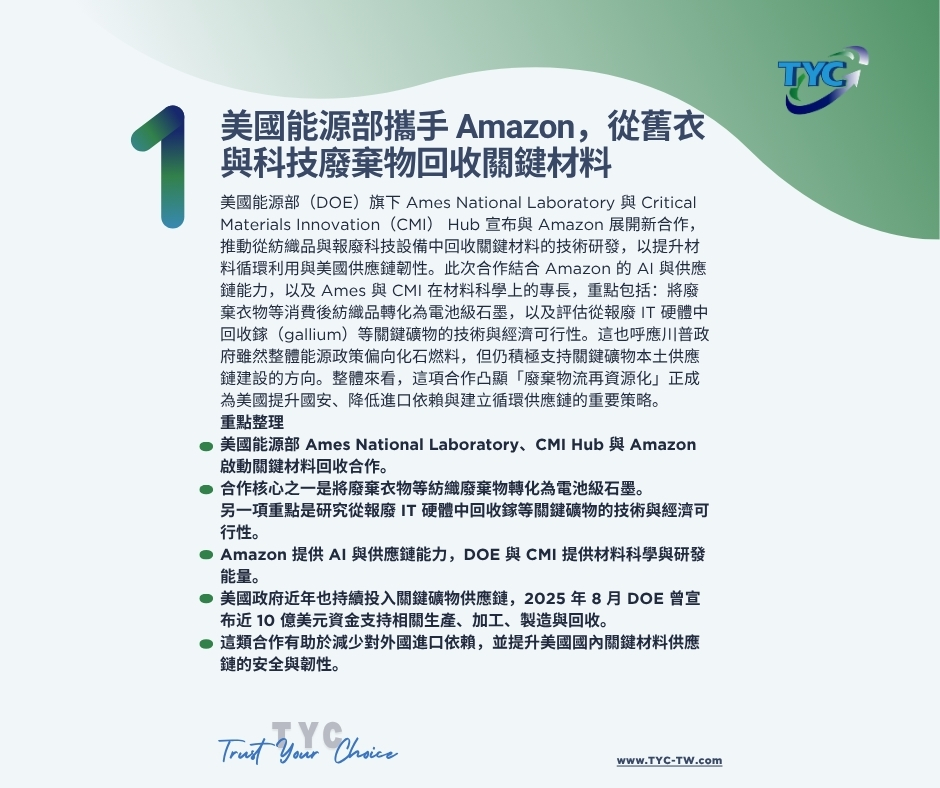
1. United States: Turning Waste into Critical Materials
The U.S. Department of Energy (DOE), in partnership with Amazon, is advancing technologies to recover critical materials from textile waste and end-of-life electronics, including converting discarded clothing into battery-grade graphite.
This initiative reflects a broader strategy:
👉 Integrating waste-to-resource systems into national supply chain security
👉 Reducing reliance on imported critical minerals
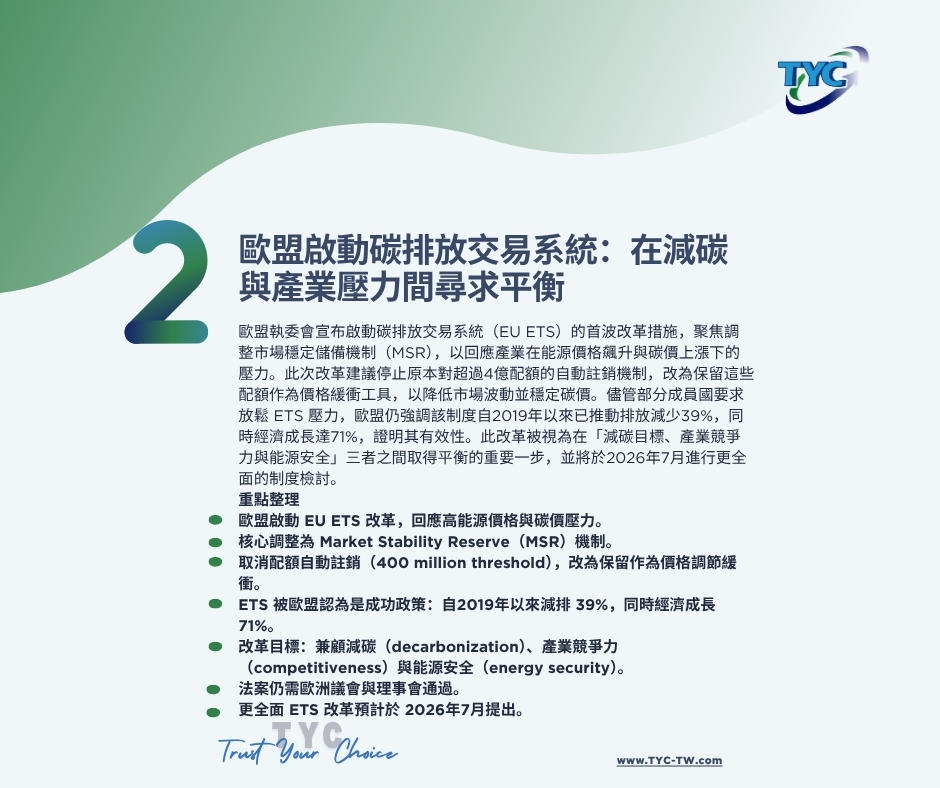
2. EU ETS Reform: A New Balance Between Carbon and Competitiveness
The European Union is adjusting its Emissions Trading System (EU ETS), particularly the Market Stability Reserve (MSR), to improve price stability by retaining allowances as a buffer instead of invalidating them.
Key outcomes since 2019:
-
–39% emissions reduction
-
+71% economic growth
This signals a shift from carbon pricing as a policy tool to a core economic mechanism.
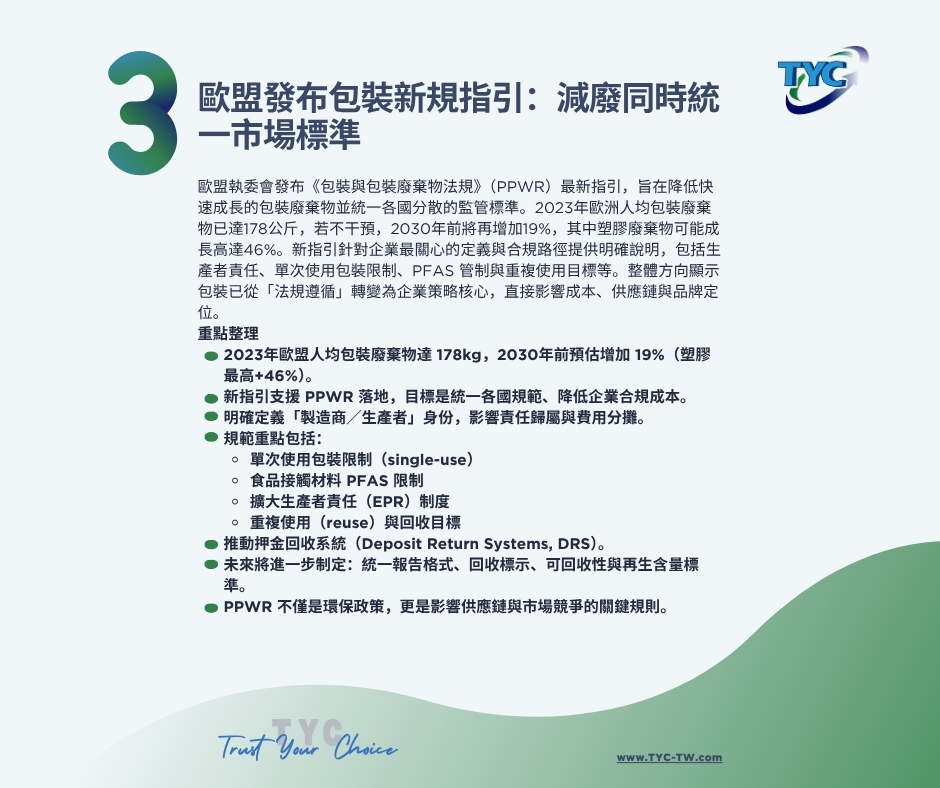
3. EU PPWR: Packaging Becomes a Strategic Supply Chain Issue
The EU’s Packaging and Packaging Waste Regulation (PPWR) introduces major changes in response to rising waste levels (178 kg per capita in 2023).
Key measures include:
-
Restrictions on single-use packaging
-
PFAS limits in food-contact materials
-
Expanded Extended Producer Responsibility (EPR)
-
Reuse and recycling targets
👉 Packaging is no longer just compliance — it is now a core driver of cost, design, and supply chain strategy.
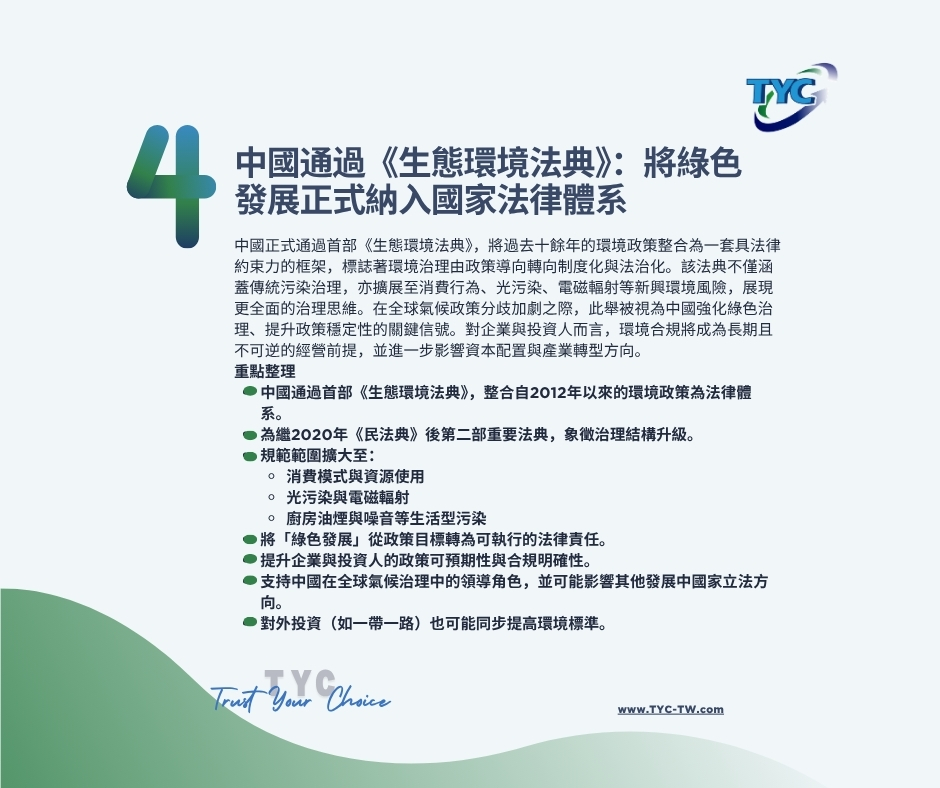
4. China: Environmental Governance Enters the Legal Era
China has enacted its first Ecological and Environmental Code, consolidating over a decade of policies into a unified legal framework.
The code expands beyond industrial emissions to include:
-
Consumption patterns
-
Light pollution and electromagnetic exposure
-
Everyday environmental impacts
👉 This marks a shift from policy direction to enforceable legal governance, strengthening regulatory predictability and global influence.
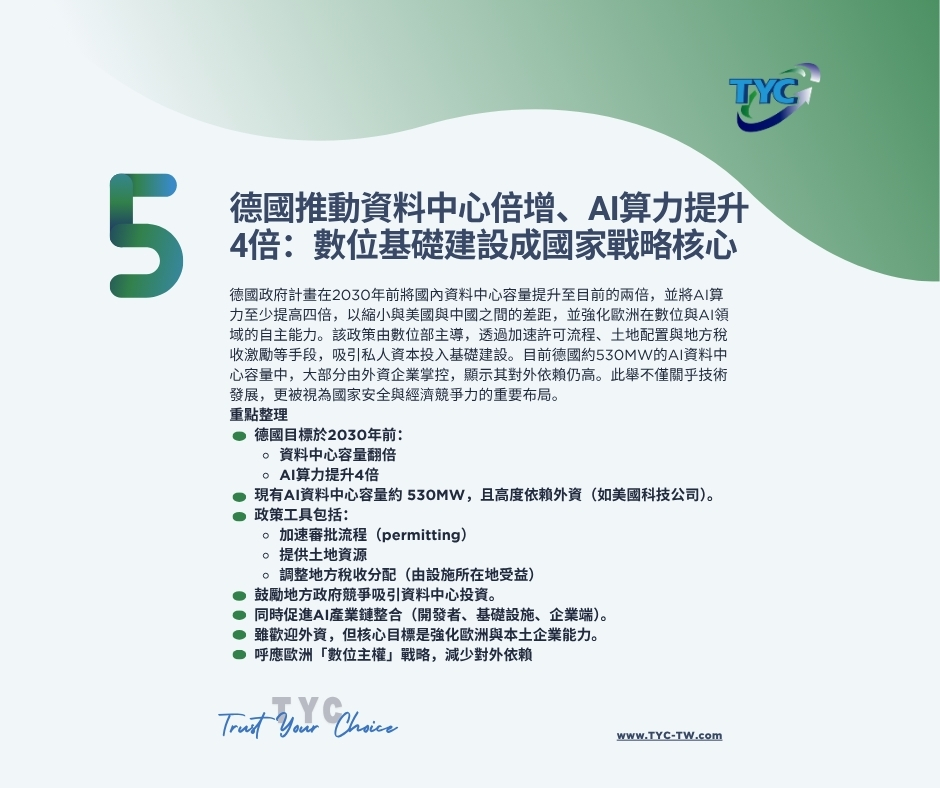
5. Germany: AI Infrastructure as Strategic Backbone
Germany plans to:
-
Double data center capacity
-
Quadruple AI processing power by 2030
Supported by faster permitting, land allocation, and tax incentives, this initiative reflects Europe’s push toward digital sovereignty.
👉 AI infrastructure is now viewed as critical as energy and transportation systems.
🔍 TYC Perspective: Materials & Carbon Are the New Control Points
These developments point to a fundamental shift:
👉 The next phase of competition is not just about energy or technology — it is about materials and carbon control.
Three Structural Changes:
1. Waste → Resource
From critical mineral recovery to packaging regulation
👉 Recycled materials (PCR) are becoming standard in supply chains
2. Carbon → Cost Driver
Carbon markets, environmental laws, and EPR systems are converging
👉 Material selection directly impacts Scope 3 emissions and cost structure
3. Infrastructure × Materials
AI and data centers are expanding rapidly
👉 Demand for low-carbon, durable, and recyclable materials is accelerating
🌱 TYC Solutions: Enabling Low-Carbon Supply Chains from the Material Level
At TYC, we translate circular economy principles into practical solutions:
-
Converting waste plastics into high-performance recycled materials (HDPE, PP, LDPE)
-
Building traceable supply chains (GRS-certified)
-
Providing product carbon footprint and reduction solutions (ISO 14067 )
-
Developing closed-loop recyclable materials such as TEXWOOD®
We believe future competitiveness will be defined by:
👉 Low-carbon materials × Circular design × Carbon data transparency
🔗 Learn more about TYC’s circular materials and carbon solutions:
👉 👉減碳試算