
NEWS & EVENTS

- Home
- News
- ESG Weekly News
- ESG International Weekly News 11/2 -11/8
ESG International Weekly News 11/2 -11/8
November 10,2026
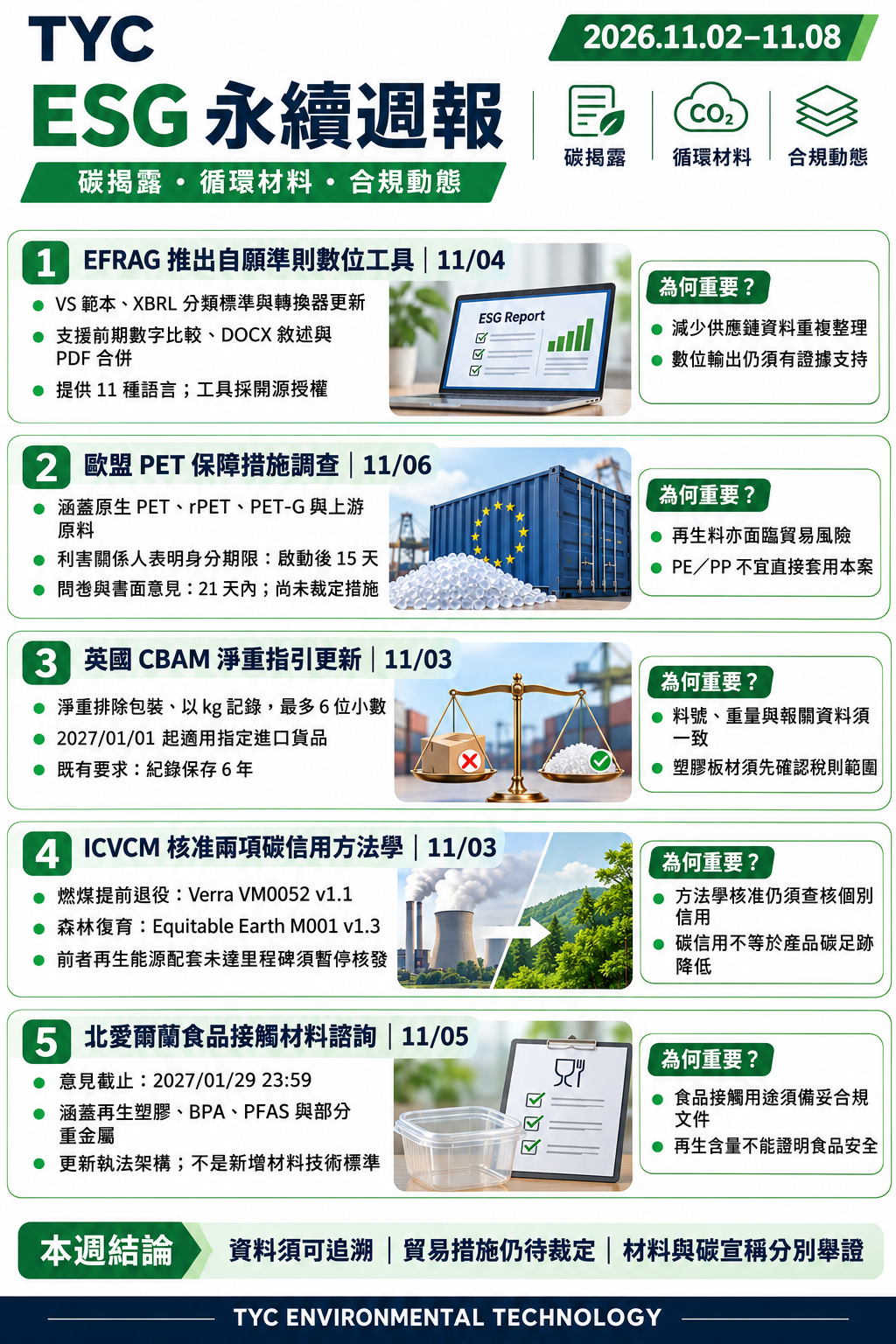
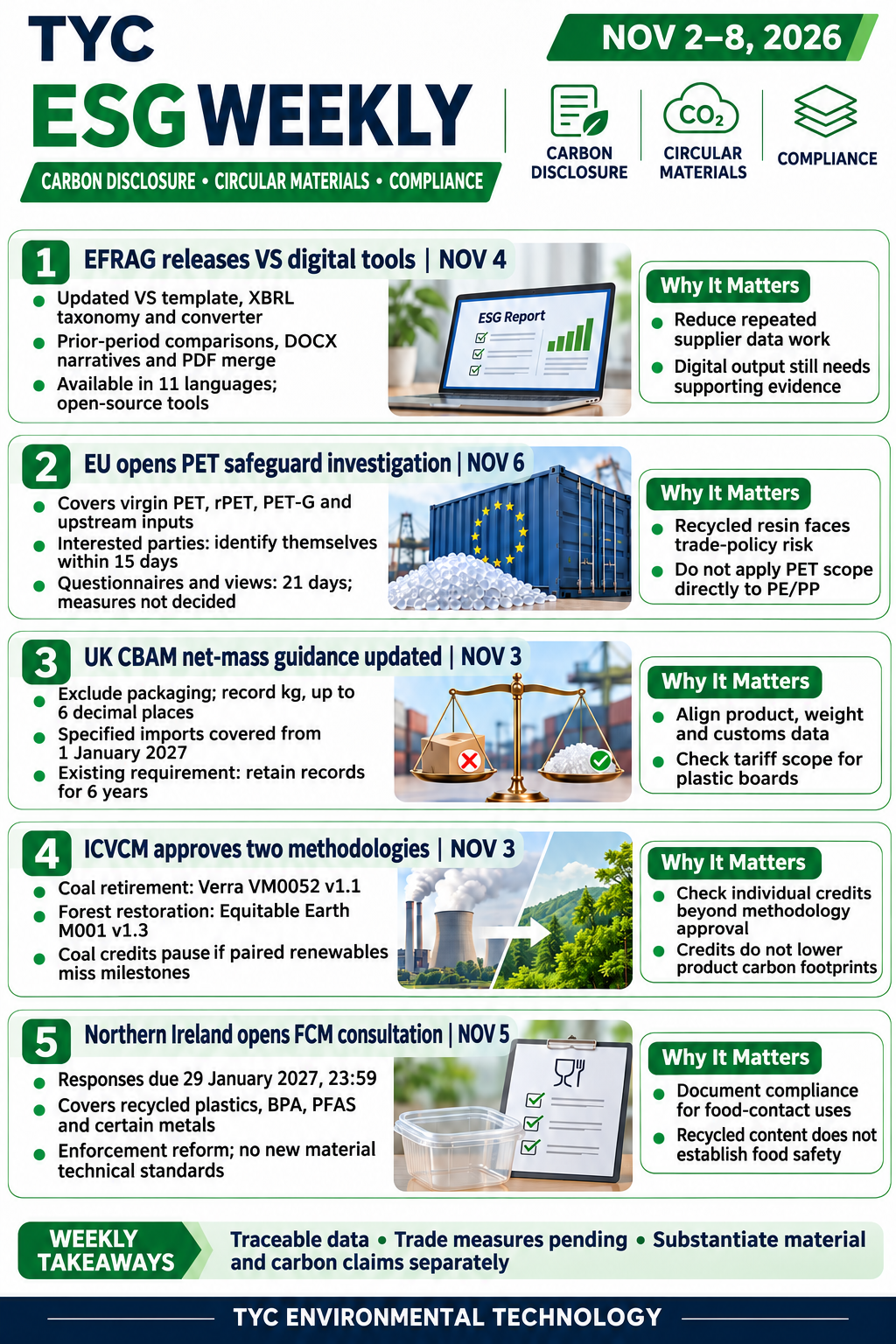
TYC ESG Weekly
November 2–8, 2026 | Carbon Disclosure, Circular Materials & Compliance
This week’s developments highlight the growing importance of consistent sustainability data, product-specific compliance and careful substantiation of environmental claims.
1. EFRAG releases updated voluntary sustainability reporting tools
November 4, 2026 | Tools released
Confirmed developments
-
EFRAG updated its Voluntary Standard digital template, XBRL taxonomy and converter.
-
Users can upload previous reporting templates to compare numerical disclosures across periods.
-
New features support DOCX narratives and merging Inline XBRL reports with PDFs.
-
The tools are available in 11 languages under an open-source licence. This release does not itself introduce new CSRD or ESRS obligations.
Why it matters — analysis
Standardised reporting tools can help suppliers reduce repeated questionnaire work and inconsistent datasets. Their value depends on reliable underlying records: reporting boundaries, calculation methods, evidence and verification status still require oversight. Businesses adopting the tools should establish data ownership and update procedures alongside the reporting format.
2. EU opens PET safeguard investigation covering recycled PET
November 6, 2026 | Investigation initiated; measures undecided
Confirmed developments
-
The European Commission opened an investigation into whether increased imports of PET resin chemicals are causing serious injury to EU industry.
-
Coverage includes virgin PET, recycled PET, PET-G and specified upstream chemical inputs.
-
Interested parties have 15 days after initiation to identify themselves and generally 21 days to submit questionnaires, written views or hearing requests.
-
Initiation does not itself impose new tariffs, quotas or an import ban; any measures remain subject to further assessment.
Why it matters — analysis
Recycled origin does not automatically remove trade-remedy exposure. Potential restrictions could change landed costs, sourcing decisions and contract terms. Relevant businesses should review responsibility for duties, price adjustments and delivery commitments while retaining origin and classification evidence. A specific duty or price increase cannot yet be assumed.
Official source: European Commission
Official source: WTO — participation deadlines
3. UK CBAM guidance clarifies net-mass records
November 3, 2026 | Implementation guidance updated
Confirmed developments
-
HMRC clarified how importers should record net mass; the update does not establish a new CBAM.
-
Records exclude packaging and use kilograms, with up to six decimal places and specified rounding instructions.
-
UK CBAM is scheduled to cover specified imports from January 1, 2027, across aluminium, cement, fertiliser, hydrogen, and iron and steel.
-
Existing requirements include six-year record retention and verification evidence when actual emissions are reported.
Why it matters — analysis
Emissions intensity must connect to the correct product, quantity and import period. Different weight conventions across invoices, packing lists, ERP systems and customs records can create reporting discrepancies and reconstruction costs. Product classification should be checked before assuming coverage simply because a product is used in construction.
Official source: HMRC — record-keeping guidance
Official source: HMRC — policy summary
4. ICVCM approves coal-retirement and forest-restoration methodologies
November 3, 2026 | Voluntary carbon-market methodology approvals
Confirmed developments
-
ICVCM approved Verra VM0052 v1.1 and Equitable Earth M001 v1.3 against its Core Carbon Principles assessment requirements.
-
VM0052 addresses accelerated retirement of financially viable, grid-connected coal plants paired with new renewable electricity.
-
Requirements include conflict management, grid analysis and renewable-energy milestones; missed milestones pause crediting.
-
M001 requires native species and community engagement and prohibits commercial timber production and harvesting.
Why it matters — analysis
Methodology approval helps buyers screen potential credits but does not replace project-level diligence. Buyers still need to check the applicable version, vintage, issuance, retirement and label eligibility. Approval alone does not substantiate a product-emissions reduction or justify every carbon-neutrality claim.
5. Northern Ireland consults on food-contact-material enforcement
November 5, 2026 | Open consultation; legislation not finalised
Confirmed developments
-
The FSA opened a 12-week consultation, closing January 29, 2027, at 23:59.
-
The proposal consolidates authority responsibilities, offences, penalties, Improvement Notices and enforcement arrangements.
-
It covers recycled-plastics Regulation EU 2022/1616, BPA, plastics, good manufacturing practice and specified PPWR provisions.
-
It creates no new material technical standards. Its PPWR scope is limited to specified heavy-metal and PFAS restrictions in food-contact packaging.
Why it matters — analysis
The focus is practical enforcement of existing requirements. Relevant suppliers need traceability, evidence of eligible recycling processes, declarations and supporting documentation. Recycled-content certificates and carbon-footprint reports cannot independently establish food-contact safety. Circularity and chemical safety require separate assessment and evidence.
Official source: FSA — consultation documents and deadline
TYC Perspective
For TYC, the common priority is to maintain traceable information that can support both customer disclosure requests and product assessments. PCR HDPE, LDPE and PP records should connect feedstock, batch quality, recycled content and relevant environmental data. TEXWOOD assessments should draw on application-specific performance and footprint evidence.
Exposure must remain product-specific: the PET investigation should not automatically be extended to PE/PP, and construction use alone does not establish CBAM coverage. Food-contact applications require their own safety and process assessments.
Across external communications, recycled content, recyclability, product carbon footprints and carbon-credit use should be explained separately, with appropriate boundaries, methods and evidence for each claim.