
NEWS & EVENTS

- Home
- News
- ESG Weekly News
- ESG I International Weekly News 10/26 -11/1
ESG I International Weekly News 10/26 -11/1
November 03,2026
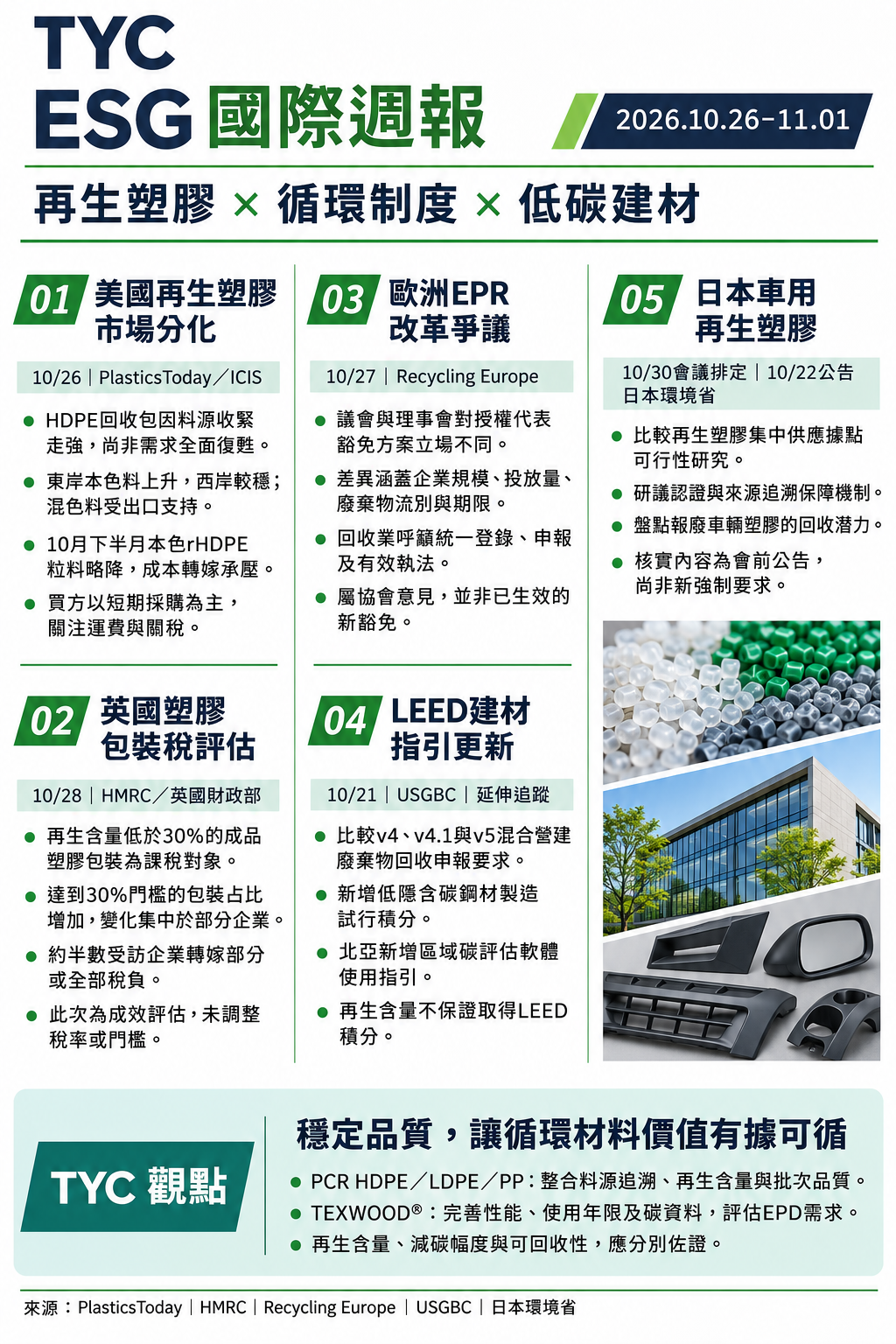
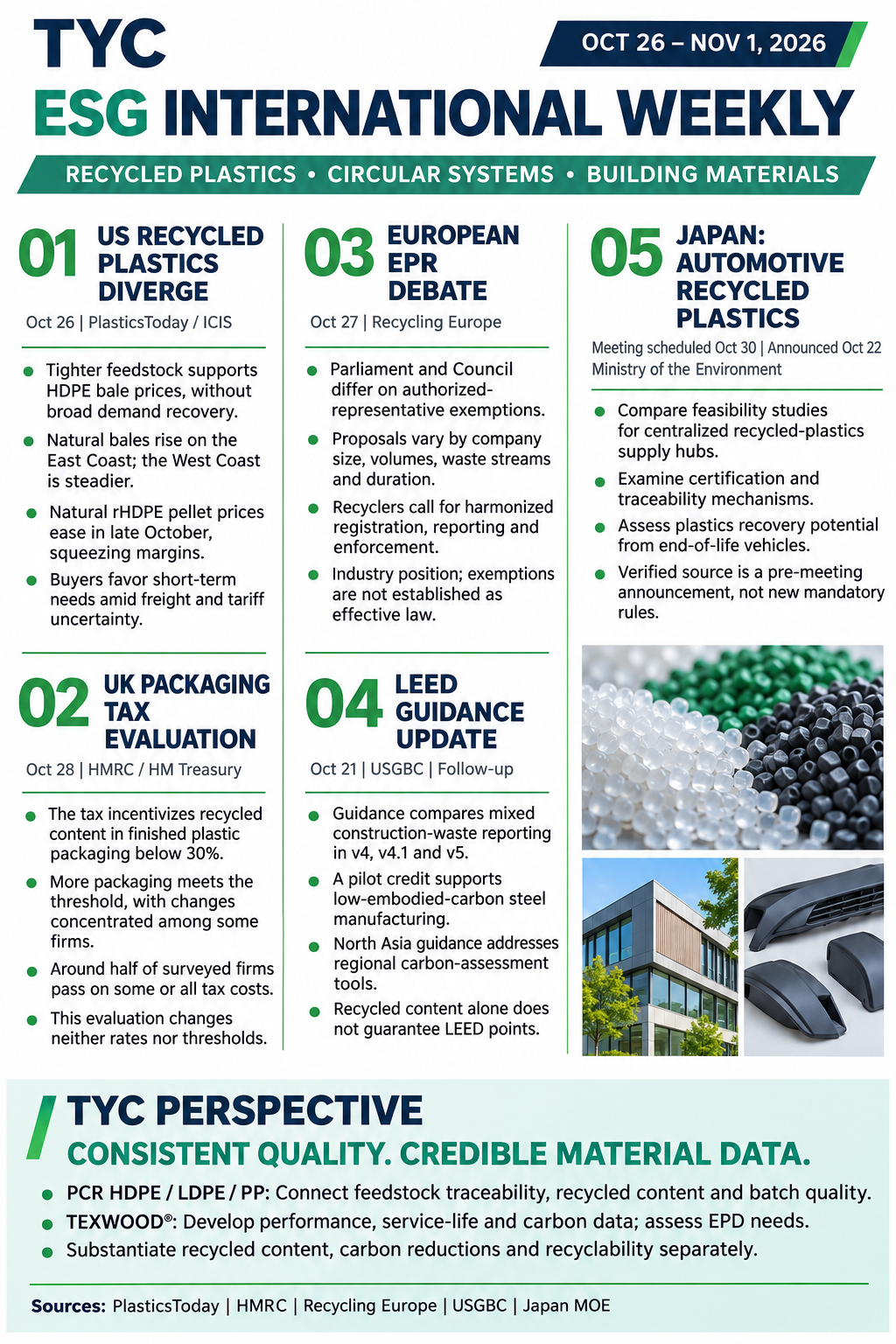
TYC ESG International Weekly | Five Developments in Recycled Plastics, Circular Systems and Low-Carbon Building Materials
October 26–November 1, 2026 | Including a building-materials follow-up
From US recycled-plastics markets and the UK Plastic Packaging Tax to European recycling policy, LEED guidance and Japan’s automotive recycled-plastics initiative, this edition examines how consistent quality, traceability and product information support circular-material applications.
This edition includes three updates published during the reporting week, LEED guidance released on October 21, and Japan’s announcement of an industry–government–academia meeting scheduled for October 30.
1 | US Recycled-Plastics Markets Diverge as Feedstock Tightens
Published: October 26, 2026
PlasticsToday, citing ICIS analysis, reported mixed conditions across US recycled-plastics markets in October. Tightening feedstock supported some recovered-material prices, while cautious downstream purchasing continued to constrain pellet prices and recyclers’ margins.
HDPE bale prices strengthened primarily because of tighter feedstock availability, rather than a broad recovery in end-use demand. Natural HDPE bale prices increased on the East Coast while remaining more stable on the West Coast. Mixed-color bales received support from export demand.
Pellet prices followed a different direction. Natural food-grade and non-food-grade rHDPE pellet prices declined slightly in the second half of October, indicating that higher feedstock costs did not necessarily translate into higher selling prices.
Buyers continued to prioritize short-term requirements, with freight costs and tariff uncertainty influencing inventory decisions and longer-term purchasing commitments.
These developments highlight the need to assess recycled-material markets by feedstock, pellet grade and region, rather than treating a single price movement as evidence of stronger overall demand.
2 | UK Plastic Packaging Tax Evaluation Highlights the Influence of the 30% Recycled-Content Threshold
Published: October 28, 2026
HM Revenue & Customs and HM Treasury published the final evaluation of the UK Plastic Packaging Tax, examining changes in packaging design, recycled-material use and cost allocation since its introduction.
Implemented in April 2022, the tax creates a financial incentive to increase recycled content in finished plastic packaging containing less than 30% recycled plastic. One of the clearest observed behavioral changes was an increase in packaging meeting the 30% threshold, although the change was concentrated among a subset of businesses.
Around half of surveyed businesses reported passing some or all of the tax cost to customers. This indicates that material-selection decisions are influenced by taxation, packaging performance and customer requirements, alongside resin prices.
The publication is a policy evaluation and does not change tax rates or thresholds. The government also could not attribute all observed environmental improvements solely to the tax. Recycled-content percentages and product carbon reductions remain separate claims requiring separate evidence.
Official source: UK Government—Final Plastic Packaging Tax Evaluation
3 | European Recyclers Raise Concerns over EPR Reform and Cross-Border Responsibilities
Published: October 27, 2026
Recycling Europe issued a statement highlighting differences between the European Parliament’s and Council’s positions on proposed exemptions from the requirement to appoint an authorized representative under Extended Producer Responsibility (EPR).
According to the association, the approaches differ in company-size eligibility, packaging volumes, waste streams and exemption periods. Recycling Europe argues that differing rules could increase the complexity of cross-border registration, reporting and responsibility allocation.
The association also raised concerns about recycling-system funding. It warned that weak enforcement could enable free-riding and shift costs to compliant producers and recyclers.
Its recommendations include harmonized registration, a single reporting platform, full cost coverage and effective enforcement.
This update represents an industry association’s position on an ongoing legislative process. The proposals should not be presented as exemptions already in force.
4 | LEED Updates Construction-Waste Reporting and Embodied-Carbon Guidance
Published: October 21, 2026 | Building-materials follow-up
The US Green Building Council (USGBC) released its October LEED updates, covering construction-waste reporting, low-embodied-carbon materials and regional assessment guidance.
New guidance compares documentation requirements for commingled construction and demolition waste recycling rates across LEED v4, v4.1 and v5. It explains what is required, permitted and restricted when reporting these rates.
The updates also introduce a pilot credit for innovative low-embodied-carbon steel manufacturing, intended to encourage the production and adoption of commercially available lower-carbon steel construction products.
For North Asia, regional guidance addresses the use of software tools to support LEED v5’s “Quantify and Assess Embodied Carbon” prerequisite.
For building-material suppliers, these developments emphasize the connection between product information and project documentation. Recycled content or recyclability alone does not guarantee that a product will contribute to LEED points; supporting information must address the requirements of the relevant credit or prerequisite.
5 | Japan Advances Automotive Recycled-Plastics Discussions, Focusing on Stable Supply and Traceability
Meeting scheduled: October 30, 2026 | Announcement published: October 22
Japan’s Ministry of the Environment announced an industry–government–academia consortium meeting scheduled for October 30 to discuss mechanisms supporting the stable supply and use of recycled plastics in automotive applications.
The planned agenda included a cross-analysis of feasibility studies for centralized recycled-plastics supply hubs, identifying implementation challenges and potential next steps.
The meeting was also scheduled to examine certification and traceability mechanisms needed for recycled-material use, alongside the recovery potential of plastics from end-of-life vehicles.
The agenda highlights the interconnected challenges of feedstock recovery, supply aggregation, quality and reliable information in developing an automotive recycled-plastics market.
The verified information is a pre-meeting announcement. It does not establish that a new certification system or mandatory recycled-content requirement has been adopted.
Official source: Japan’s Ministry of the Environment
TYC Perspective | Supporting Circular Applications with Consistent Quality, Performance and Credible Data
This edition’s developments show that recycled-material value is shaped by feedstock availability, purchasing costs, recycling systems and product information. For TYC’s PCR HDPE, LDPE, PP and TEXWOOD® building-material applications, three priorities stand out.
Strengthen Traceability and Batch Consistency
Integrate feedstock origins, recycled-content information, quality specifications and physical-property test records to help customers assess formulation suitability. Potential automotive applications require customer-specific material and supplier qualification.
Connect Product Information to Procurement and Building-Project Needs
Provide performance, recycled-content and traceability evidence appropriate to each application. For intended TEXWOOD® uses, relevant information may include service life, maintenance, replacement and end-of-life pathways, alongside an assessment of target-market demand for Environmental Product Declarations (EPDs).
Substantiate Environmental Claims Separately
Recycled content does not establish a corresponding percentage reduction in carbon emissions. Recyclable design also requires practical collection, processing and recovery pathways. Carbon comparisons should use consistent functional units, service-life assumptions and lifecycle boundaries.
TYC will continue monitoring international policy and material-market developments to inform material development, quality management and product disclosure.