
NEWS & EVENTS

- Home
- News
- ESG Weekly News
- ESG International News 10/17-10/25
ESG International News 10/17-10/25
October 27,2026
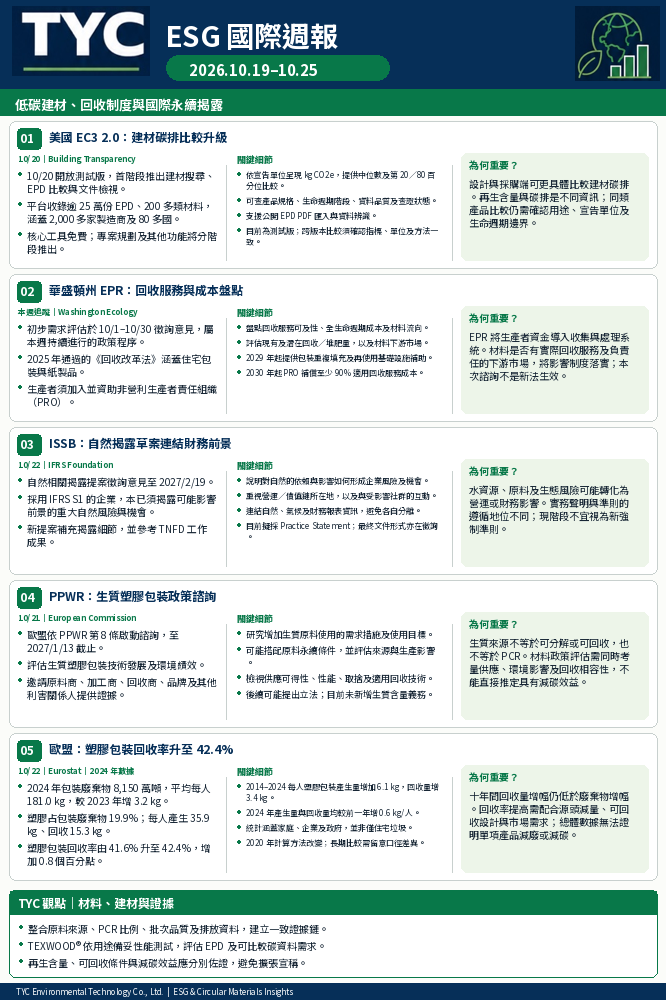
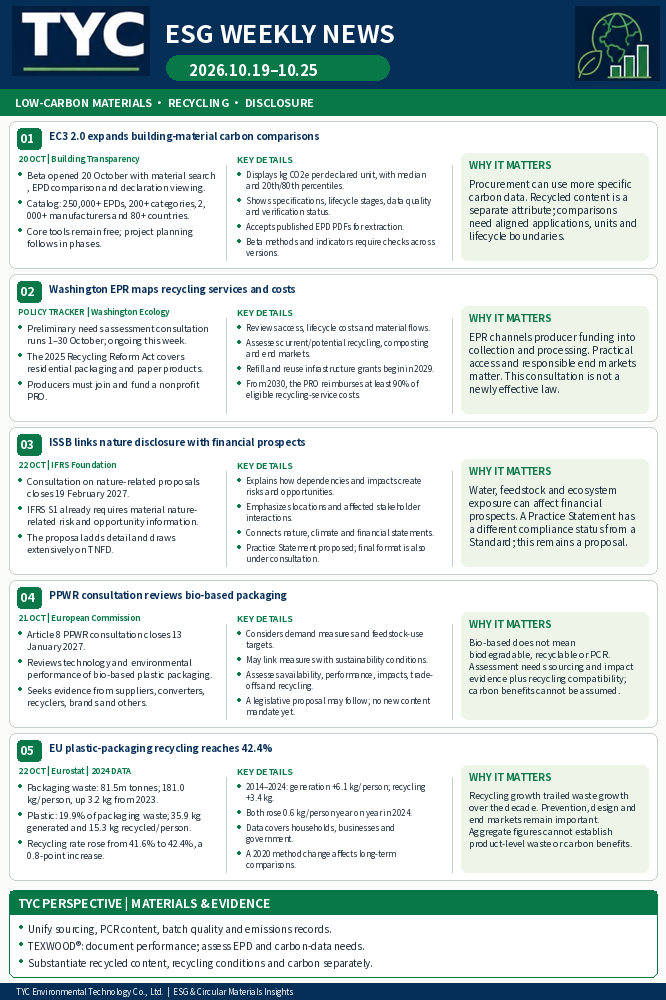
TYC ESG Weekly News
19–25 October 2026
This edition covers U.S. low-carbon building materials and packaging recycling, alongside international developments in nature disclosure, packaging policy and recycling performance. Across these topics, material selection and sustainability management increasingly depend on consistent data and traceable evidence.
1 | U.S. EC3 2.0 Beta Opens to Support Low-carbon Material Comparisons
20 October
News overview
U.S. nonprofit Building Transparency opened the EC3 2.0 beta, starting with material search and comparison features. EC3 supports embodied-carbon assessment during material specification and procurement, with more than 250,000 Environmental Product Declarations (EPDs) on the platform.www.buildingtransparency.org
Key details
- Uses EPD data to support material searches, filtering and carbon comparisons.
- Supports material specification and procurement decisions.
- The release is a beta, with additional features introduced in phases.
- Changes to how carbon values are presented mean comparisons across versions require consistent indicators and methods.www.buildingtransparency.org
Why it matters
Low-carbon material assessment requires comparable product information. Recycled content describes material sourcing, while product carbon performance requires defined functions, lifecycle boundaries and calculation methods.
2 | Washington State Continues Consultation on Packaging EPR Needs Assessment
Policy tracker | Consultation runs 1–30 October
News overview
Washington State is seeking comments on its preliminary needs assessment under the Recycling Reform Act until 30 October. The assessment examines residential recycling services, system costs, material flows and end markets to support implementation of packaging and paper-product EPR.www.ecology.wa.gov
Key details
- Assesses residents’ access to recycling services.
- Examines recycling costs across the lifecycle.
- Reviews disposal, recycling, composting and potential recovery volumes.
- Identifies which material types have end markets.www.ecology.wa.gov
Why it matters
Effective packaging recycling requires collection services, processing capacity and viable markets for recovered materials. The assessment offers insight into how state-level EPR translates policy goals into infrastructure and funding arrangements.
Source: Washington State Department of Ecology
3 | ISSB Consults on Nature-related Disclosure Proposals
22 October
News overview
The ISSB published a proposed Nature-related Disclosure Practice Statement, with consultation open until 19 February 2027. Drawing on TNFD, it addresses governance, strategy, risk management, metrics and targets, including connections between nature and climate risks.
Key details
- Companies would consider the locations of operations and value-chain activities.
- Relevant factors include water, biodiversity, land use and environmental regulation.
- Disclosure focuses on effects on companies’ financial prospects.
- The proposal is a draft Practice Statement, not an effective new mandatory Standard.
Why it matters
Nature-related issues can affect feedstock availability, operating costs, site exposure and capital expenditure. Companies need location-specific and supply-chain information to explain their risks and management responses.
4 | EU Opens Consultation on Bio-based Plastic Packaging
21 October
News overview
The European Commission opened a consultation on bio-based feedstock in plastic packaging, closing on 13 January 2027. The review falls under Article 8 of the Packaging and Packaging Waste Regulation (PPWR) and examines technology, environmental performance and possible policy measures.
Key details
- The review concerns bio-based feedstock used in plastic packaging.
- Options include demand measures and content targets.
- Sustainability conditions and environmental performance are central considerations.
- No new bio-based content obligation has yet been introduced.
Why it matters
Bio-based, PCR, biodegradable and recyclable describe different attributes. Each requires separate evidence on sourcing, content, treatment conditions and environmental performance.
5 | EU Plastic-packaging Recycling Improves as Waste Generation Rises
22 October
News overview
Eurostat reported that the EU generated 81.5 million tonnes of packaging waste in 2024, equivalent to 181 kg per person. The plastic-packaging recycling rate increased from 41.6% in 2023 to 42.4%.
Key details
- Plastic accounted for approximately 19.9% of total packaging waste.
- Plastic-packaging waste reached 35.9 kg per person, with 15.3 kg recycled.
- Between 2014 and 2024, waste generation increased by 6.1 kg per person.
- Recycling increased by 3.4 kg per person over the same period, trailing growth in waste generation.
Why it matters
Higher recycling rates need to accompany waste prevention, recyclable design and stable markets for recovered materials. Aggregate recycling figures do not substantiate individual product-level waste or carbon claims.
TYC Perspective | Supporting Circular-material Applications with Evidence
This week’s developments span building-material procurement, recycling systems and corporate disclosure. They show that circular materials need reliable performance, consistent supply and credible information to support their market value.
For PCR HDPE, LDPE, PP and TEXWOOD® building-material applications, three priorities stand out:
-
Maintain consistent material data.
Integrate feedstock sources, PCR content, quality specifications, energy, emissions and verification records to support customer reviews and supply-chain communication. -
Prepare evidence for the intended application.
Building products need relevant weathering, slip-resistance and other performance data. Assess target-market demand for EPDs, and use consistent functions, service lives and lifecycle boundaries in carbon comparisons. -
Define claims precisely.
Address recycled content, bio-based sourcing, recyclability and carbon benefits separately. Recyclable design also needs practical collection, processing and recovery pathways.
TYC will continue monitoring international policy and material-market developments to inform material development, quality management and product disclosure.